


What Happens When AI Gets Control of Your Social Media?
For years, social media automation meant one simple thing: make repetitive work faster.
Schedule a post.
Publish to multiple accounts.
Like a post.
Leave a comment.
Follow an account.
Send a message.
Collect some data.
The human still decided what to do. The software simply did it faster.
But something is changing.
AI is moving beyond generating captions and suggesting content. AI agents are increasingly being designed to interpret information, plan actions, execute workflows, and react to what happens next. In social media, that raises a much bigger question:
What happens when AI doesn't just help manage your social media — but starts deciding what should happen next?
That question sits at the center of the next generation of social media automation.
And it is also the idea behind the upcoming SuSocialPro Nexus.
Social Media Automation Was Never Really About Automation
Let's take a typical social media workflow.
You want to promote a product on Facebook, Instagram, X, TikTok, or other platforms.
The traditional workflow looks something like this:
Find something to talk about → create content → publish → wait → check results → repeat.
Automation can make this process faster.
Instead of manually publishing ten posts, you prepare the content once and let software distribute it.
Instead of manually interacting with hundreds of posts, you define a task and let automation handle repetitive actions.
Instead of checking every account individually, you manage multiple accounts from one system.
This is useful.
But there is an obvious limitation:
The software still needs you to tell it what to do.
Automation is excellent at execution.
It is much less interesting when the question becomes:
What should I do next?
That is where AI changes the conversation.
From Automation to Intelligence
Imagine that you are not simply telling your social media software:
“Find posts containing this keyword and comment on them.”
Instead, imagine giving the system a broader objective:
“Find conversations where people may have a genuine interest in what my business offers.”
Those two instructions sound similar.
They are not.
The first is a task.
The second is a goal.
A task tells software what action to perform.
A goal asks a system to understand why the action matters.
This is the fundamental shift from traditional automation toward AI-driven workflows.
AI can potentially help analyze conversations, identify patterns, prioritize opportunities, generate possible responses, and determine which actions deserve attention.
The software is no longer simply pressing buttons.
It is becoming part of the decision-making process.
The Social Media Manager May Become a System
This is where things become particularly interesting.
A social media manager today may spend hours doing things such as:
- monitoring multiple platforms
- searching for relevant conversations
- checking mentions
- finding potential customers
- preparing posts
- responding to comments
- managing multiple accounts
- reviewing engagement
- adjusting campaigns
- repeating similar tasks every day
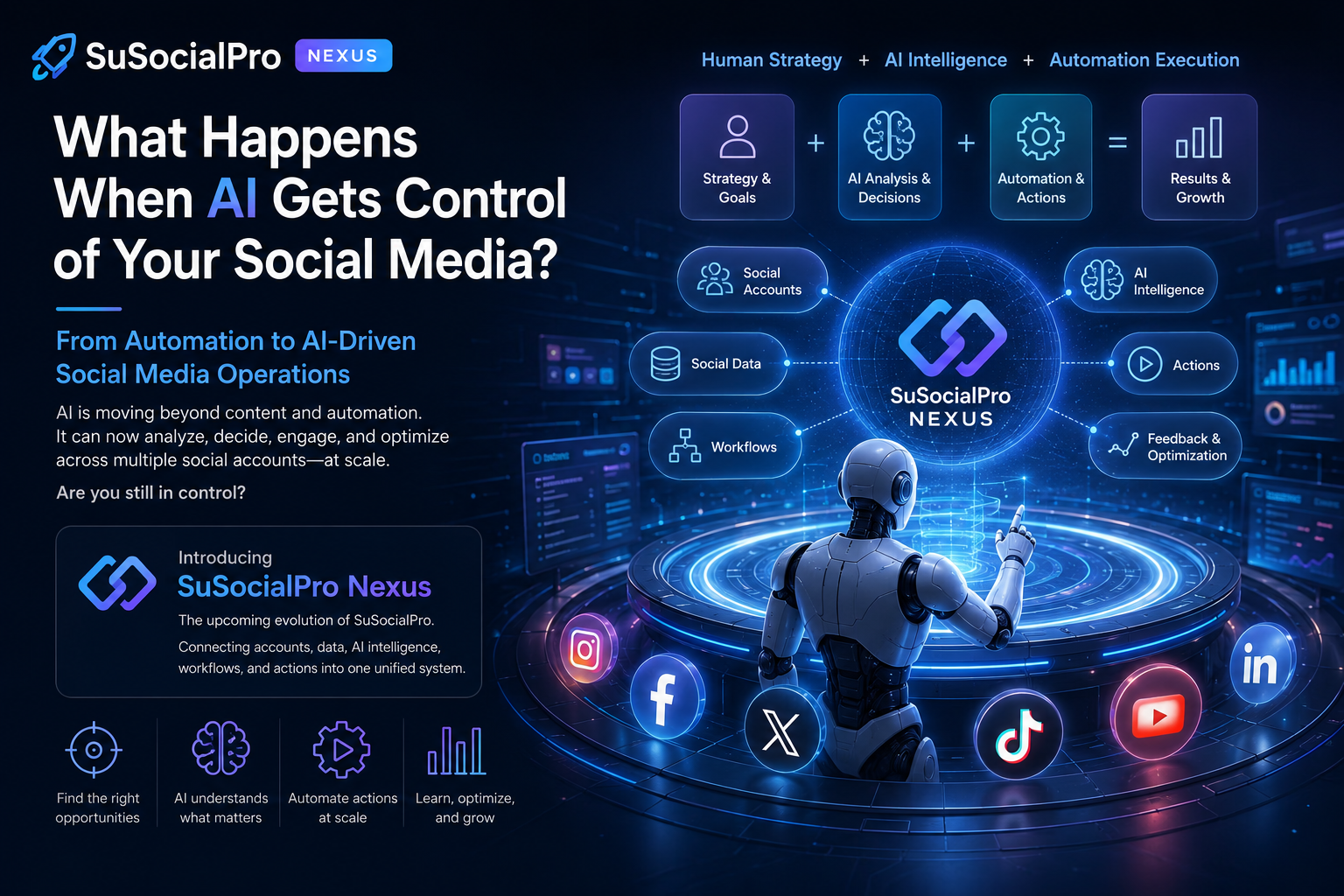
Now imagine separating this work into three layers.
Human
Defines:
Goals, brand positioning, rules, priorities and boundaries.
AI
Helps determine:
What matters, what should happen next, and how different situations should be handled.
Automation
Executes:
The repetitive actions across connected social media accounts.
This creates a completely different operating model.
The human is no longer expected to manually operate every account.
The human becomes the strategist.
AI becomes the intelligence layer.
Automation becomes the execution layer.
That is a much more powerful concept than simply calling something an “AI social media tool.”
So, What Is SuSocialPro Nexus?
SuSocialPro Nexus is the upcoming evolution of SuSocialPro.
Rather than thinking about Nexus as simply another collection of automation features, it is better understood as a new direction for how social media operations can work.
The idea is simple:
Connect social accounts, social data, AI intelligence, workflows and automated actions into a more unified system.
Think about the relationship:
Accounts → Data → Signals → AI → Decisions → Actions → Feedback
Instead of treating each step as an isolated task, Nexus is designed around the idea of connecting the entire workflow.
That distinction matters.
Because the future of social media automation may not be about adding more buttons.
It may be about creating a system where the buttons become less important.
From “What Should I Do?” to “What Should We Do Next?”
This is perhaps the biggest conceptual difference.
Traditional automation asks:
What task should I run?
AI-driven automation asks:
What opportunity should I act on?
For example, imagine a company selling a social media marketing product.
A traditional workflow might be:
- Search for “social media automation.”
- Collect relevant posts.
- Select some posts.
- Comment on them.
- Repeat tomorrow.
An intelligent workflow could potentially look very different:
- Monitor relevant conversations.
- Understand what people are discussing.
- Identify conversations related to genuine problems or needs.
- Prioritize the most relevant opportunities.
- Suggest or execute appropriate engagement.
- Observe the response.
- Feed the results back into the next workflow.
The important word here is feedback.
Without feedback, automation simply repeats.
With feedback, a system can begin to optimize.
That is where the idea of an AI-driven social media operation becomes much more interesting.
The Real Value of AI Is Not More Content
There is already an enormous amount of AI-generated content on the internet.
More captions are not necessarily the answer.
More posts are not necessarily the answer.
More comments are definitely not automatically the answer.
The real question is:
Can technology help a business spend its limited attention on the right opportunities?
That is much harder.
A social media account does not become successful simply because it publishes 100 times instead of 10 times.
A brand does not automatically acquire customers because it leaves 1,000 comments.
Scale without direction can simply produce more noise.
This is why the next generation of automation needs something more than automation itself.
It needs context, intelligence and feedback.
But Giving AI Control Creates a New Problem
There is an uncomfortable side to all of this.
If AI can make decisions, what happens when it makes the wrong decision?
A badly written post can be edited.
A badly timed campaign can be stopped.
But an AI system interacting across many accounts and platforms can potentially amplify a mistake much faster than a human could.
This is why “fully autonomous” should not automatically mean “better.”
Current discussions around social AI agents increasingly emphasize the need for human oversight, especially for sensitive public communication, crisis situations, brand judgment and high-risk decisions.
And there is an even deeper issue.
If humans become too dependent on automation, they may gradually stop understanding the decisions being made on their behalf. Recent research and commentary on AI agents has raised exactly this concern: simply putting a human somewhere in the approval chain does not necessarily guarantee meaningful oversight.
So the future should not be:
AI replaces humans.
It should be:
AI expands what humans can manage.
The Future Is Not “Human vs. AI”
The most interesting future is probably not a world where an AI wakes up one morning and completely takes over your social media.
It is much more practical than that.
Imagine a business owner managing 30, 50 or 100 social accounts.
They don't want to manually inspect every conversation.
They don't want to manually repeat every action.
But they also don't want to surrender their brand to an unpredictable black box.
They want something in between.
They want to define the strategy.
They want to define the boundaries.
They want the system to handle the scale.
They want AI to help interpret the information.
And they want to remain in control of the decisions that actually matter.
That is the balance that the next generation of social media automation needs to solve.
Why “Nexus” Matters
The word Nexus means a connection — a central point where different things come together.
That is an appropriate idea for the next stage of social media automation.
Because modern social media operations are already fragmented.
One platform here.
Another platform there.
A scheduling tool.
A scraping tool.
An AI writing tool.
An analytics dashboard.
A browser automation system.
A separate workflow.
A separate account manager.
A separate process for finding potential customers.
The problem isn't necessarily that businesses lack tools.
Sometimes they have too many disconnected tools.
The more powerful idea is to connect these pieces.
Data should connect to intelligence.
Intelligence should connect to workflows.
Workflows should connect to actions.
Actions should generate feedback.
And feedback should influence what happens next.
That is the direction represented by SuSocialPro Nexus.
The Next Generation of Social Media Automation
Social media automation started with a simple promise:
Let software do repetitive work.
Then AI added another:
Let software help create and understand content.
The next stage is more ambitious:
Let intelligent systems participate in the entire workflow.
That doesn't mean humans disappear.
It means their role changes.
Instead of spending most of their time operating the machine, they can spend more time defining:
- What the business wants to achieve
- Who it wants to reach
- What the brand should sound like
- What actions are acceptable
- What decisions require human approval
- What outcomes actually matter
AI can then help turn those objectives into repeatable operations.
Automation can execute them at scale.
And data can tell the system what happened.
That is a much more interesting future than simply “AI writes your social media posts.”
So, What Happens When AI Gets Control of Your Social Media?
Maybe the better question is:
What happens when AI gets enough control to become useful — but not so much control that humans become irrelevant?
That is the line worth exploring.
Because the future of social media automation will not be decided by who can automate the most actions.
It will be decided by who can build the most effective relationship between:
Human strategy.
AI intelligence.
Automated execution.
Continuous feedback.
SuSocialPro Nexus is being built with this direction in mind.
It is an upcoming new version of SuSocialPro — not simply an attempt to add another “AI” button to an existing automation platform, but a step toward a different way of thinking about social media operations.
The goal is not to make humans disappear from social media.
The goal is to make one human capable of operating at a scale that previously required an entire team.
And perhaps that is the real future of social media automation.
Not AI taking control of your social media.
But humans finally having a system powerful enough to control social media at scale.
If you are interested in SuSocialPro Nexus and want to learn more about the upcoming version, contact us and let's talk about what AI-driven social media automation could look like for your business.
WhatsApp: +86 193 3223 6974
Telegram: @spinnerchief