



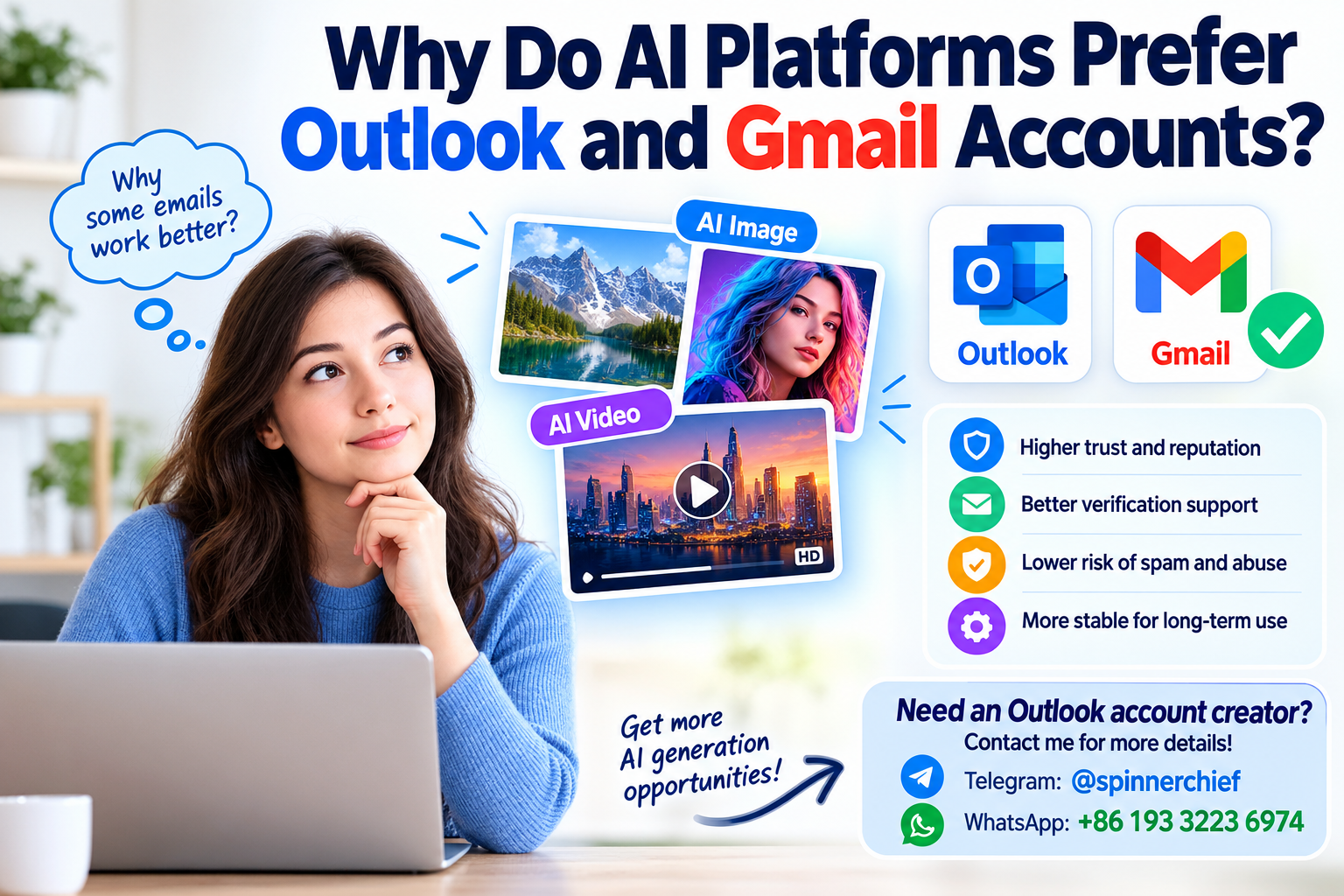
Why Do AI Platforms Prefer Outlook and Gmail Accounts?
If you use AI platforms for image or video generation, you may have noticed something interesting: not every email address works the same way.
Some AI websites accept an account created with an Outlook or Gmail address without much trouble, while accounts using temporary, disposable, or lesser-known email services may be rejected, require additional verification, or have limited access to certain features.
This raises an important question:
Why does the email provider matter when creating an account for an AI platform?
The answer has a lot to do with account trust, verification, and abuse prevention.
Not Every Email Address Has the Same Reputation
From a user's perspective, an email address is simply an email address.
For an online platform, however, the situation can be very different.
Established providers such as Outlook and Gmail have been operating at a huge scale for many years. Their email systems support account recovery, security verification, spam protection, and other mechanisms that help platforms determine whether an account is likely to be a normal, long-term user account.
By comparison, temporary and disposable email services are often designed for short-term registrations. Because these addresses can be created and abandoned quickly, some websites may apply additional restrictions to them.
This does not mean that every Outlook or Gmail account will automatically be accepted, or that every other email provider will be rejected. It simply means that the email provider can be one of the signals an online platform considers when evaluating an account.
Why Is This More Noticeable With AI Image and Video Platforms?
The issue has become more noticeable as AI image and video generation services have become popular.
Many AI platforms provide users with some form of free or limited generation:
Free image generations
Free video generations
Daily credits
Monthly credits
Trial credits
Limited access to premium AI models
For example, a platform might allow a new account to generate a certain number of images or videos before requiring a subscription.
This creates a natural demand for multiple accounts among users who need to work with different projects, teams, or services.
At the same time, AI platforms have to protect their systems from spam, fake accounts, automated registrations, and abuse of free-generation credits.
As a result, account verification can become stricter than users expect.
Why Outlook and Gmail Are Common Choices
Outlook and Gmail are two of the most recognizable mainstream email providers.
They are commonly used for:
Personal accounts
Business accounts
Software registrations
SaaS platforms
AI tools
Online services
Account recovery
When an AI platform asks for an email address, using an established provider can therefore be a more reliable starting point than using a disposable email service.
However, it is important to understand one thing:
Using Outlook or Gmail does not guarantee that an account will be accepted or that an AI platform will provide unlimited access.
The platform may consider many other factors as well.
Email Is Only One Part of Account Trust
An email address is not the only thing an AI platform can evaluate.
Depending on the service, other signals may include:
IP Address
The IP address associated with an account can be an important factor. Platforms may detect unusual registration or login patterns and apply additional verification.
Browser and Device Information
Websites can also use browser and device-related signals to help identify unusual activity.
Verification Requirements
Some services may require phone verification, email verification, CAPTCHA challenges, or other security checks.
Account Activity
The way an account behaves after registration can also matter. Unusual activity may trigger additional security measures.
Payment Information
For paid services, billing and payment information can become another part of the account verification process.
This is why simply changing the email provider does not automatically solve every account-related problem.
Why Disposable Email Addresses Can Be Less Reliable
Temporary email addresses are convenient when you only need an address for a short period of time.
However, they can be problematic when you need a long-term account.
For example, you may later need to:
Reset the password
Receive a security notification
Verify the account again
Recover the account
Receive important service emails
If the temporary email address is no longer available, recovering the account can become difficult or impossible.
For AI tools that you plan to use regularly, a stable email account is generally a better choice.
What If You Need a Large Number of Accounts?
This is where things become more complicated.
If you are managing a large number of legitimate accounts for different projects, testing environments, teams, or business operations, creating each account manually can take a significant amount of time.
For example, manually creating accounts can involve:
Opening the registration page
Entering account information
Creating passwords
Completing email verification
Handling additional verification steps
Recording the account information
Repeating the process for the next account
Doing this repeatedly can become a tedious administrative task.
If your use case is legitimate and you need to manage a large number of Outlook accounts, an account creation or account management tool can help automate repetitive parts of the workflow.
Need an Outlook Account Creator?
If you need an Outlook account creator for your own legitimate account-management or business workflow, you can contact me to discuss your requirements.
I can provide more information about available solutions and whether an account creator can be customized for your specific workflow.
Telegram: @spinnerchief
WhatsApp: +86 193 3223 6974
Before starting a project, it is always better to explain your exact requirements first, including the number of accounts, the workflow you need, and how the accounts will be used.
Outlook vs. Gmail vs. Temporary Email
There is no universal rule that says one email provider will work on every AI platform.
However, as a general comparison:
| Email Type | Long-Term Use | Account Recovery | Platform Acceptance |
|---|---|---|---|
| Outlook | Good | Good | Often widely supported |
| Gmail | Good | Good | Often widely supported |
| Custom Domain Email | Good | Depends on provider | Depends on platform |
| Temporary Email | Limited | Often difficult | More likely to face restrictions |
| Disposable Email | Limited | Often difficult | More likely to face restrictions |
The important point is that email provider reputation and account stability can matter, particularly when using services that have strong account-verification systems.
Don't Assume That More Accounts Means Unlimited AI Generation
Another important point is that creating multiple accounts does not necessarily mean unlimited access to an AI platform.
Every service has its own terms, limits, verification systems, and usage policies.
An account may have:
A daily generation limit
A monthly credit limit
Feature restrictions
Verification requirements
Subscription requirements
Additional security checks
Therefore, if you are planning to use multiple accounts for an AI workflow, you should always check the specific platform's rules before doing so.
The Bottom Line
If you are using AI image and video platforms, the email address you use can matter more than you might expect.
Established providers such as Outlook and Gmail are widely used and generally provide a more stable foundation for online accounts than temporary or disposable email services.
However, email is only one part of the picture. AI platforms may also evaluate IP addresses, browser and device signals, verification requirements, account activity, and other factors.
If you need to manage a large number of Outlook accounts for a legitimate business or technical workflow and are looking for an Outlook account creator, feel free to contact me:
Telegram: @spinnerchief
WhatsApp: +86 193 3223 6974
Explain your requirements, and we can discuss the most suitable approach for your workflow.