


The 10,000-Account Stress Test: Can Codex Build It, and Can You Actually Operate It?
Imagine you have 10,000 social media accounts.
Not 10.
Not 100.
Not even 1,000.
10,000 accounts.
Each account may have its own content, schedule, targets, tasks, settings, and workflows.
Now imagine asking Codex to build a system that can automate all of them.
Codex can write code. It can help build APIs, automate repetitive tasks, create workflows, generate dashboards, and customize software around your exact requirements.
So, can Codex manage 10,000 social media accounts?
Technically, you can build a system that does it.
But there is a more interesting question:
Can you actually operate what Codex builds?
That is where the 10,000-account problem becomes much more complicated.
The 10,000-Account Stress Test
Let's run a simple thought experiment.
You have:
- 10,000 social media accounts
- Multiple social platforms
- Thousands of scheduled tasks
- Large amounts of content
- Different account groups
- Different campaigns
- Different posting schedules
- Thousands of automation actions
Your first requirement is simple:
“Build me a system that can automate these accounts.”
This is where Codex becomes extremely useful.
You can describe the workflow, define the requirements, and let an AI coding agent help generate the software needed to make it happen.
Need a custom API integration?
Build it.
Need a database?
Build it.
Need a dashboard?
Build it.
Need a special workflow?
Build it.
Need to change the behavior of a task?
Modify the code.
This is the strength of an AI coding agent.
But then comes the second requirement.
“Now operate all of this every day.”
That's a different problem.
Test #1: Can Codex Build the Automation?
Let's give Codex credit first.
This is where Codex is powerful.
A developer can use it to accelerate the creation of custom automation systems.
For example, imagine you want a workflow that looks like this:
Account → Content → Schedule → Action → Result
Codex can help you build the components behind that workflow.
You could create custom logic for:
- account processing
- content distribution
- scheduling
- API requests
- task queues
- databases
- reporting
- error handling
- dashboards
And because the system is custom-built, you aren't limited to whatever features happen to exist inside a traditional software product.
This is extremely valuable when you have a unique technical requirement.
But building the machine is only the first test.
The real stress test starts after the machine is running.
Test #2: 10,000 Accounts Are Not Just 10,000 Accounts
This is where scale changes the problem.
With 10 accounts, you can probably understand what's happening.
With 100 accounts, you can create a few groups and workflows.
With 1,000 accounts, you need a more structured management system.
With 10,000 accounts, you are no longer simply managing accounts.
You are managing a system of systems.
Consider a simple structure:
10,000 Accounts
↓
Account Groups
↓
Content Pools
↓
Campaigns
↓
Automation Tasks
↓
Schedules
↓
Execution
↓
Monitoring
↓
Reports
Now the challenge isn't simply whether your code can process 10,000 records.
The challenge becomes:
Can a human operator understand and control everything that is happening?
That is a completely different definition of scalability.
Test #3: What Happens When 347 Tasks Fail?
Let's make the scenario more realistic.
You wake up on Monday morning.
Your system processed thousands of automation tasks overnight.
But 347 tasks failed.
Now what?
You need to know:
- Which accounts were affected?
- Which tasks failed?
- Why did they fail?
- Were the failures temporary?
- Should the tasks be retried?
- Which accounts should be paused?
- Which campaigns are affected?
- Did the failure affect other workflows?
This is where automation becomes an operations problem.
The question is no longer:
“Can AI write the code?”
The question is:
“Can my team operate the system when something goes wrong?”
At 10 accounts, you might manually check things.
At 10,000 accounts, you need visibility, organization, controls, and a reliable way to manage exceptions.
Test #4: What Happens When You Need to Change 2,000 Accounts?
Now imagine your strategy changes.
You want to modify the workflow for 2,000 accounts.
At the same time:
- 3,000 accounts should continue using the existing workflow.
- 2,000 accounts need a new schedule.
- 1,000 accounts need different content.
- 500 accounts need to be paused.
- The remaining accounts should continue running normally.
Can you change everything without affecting the wrong accounts?
This is not primarily a coding question.
It is a management question.
The bigger your operation becomes, the more important account grouping, task management, scheduling, monitoring, and centralized control become.
Test #5: The Hidden Cost of Automation
This creates something that doesn't get discussed enough:
Automation Debt
AI coding tools make software development dramatically faster.
That is a huge advantage.
But there is a potential downside.
You can also create automation faster than you can create the systems needed to manage that automation.
A developer might build:
- one automation workflow
- then another
- then another
- then add a custom exception
- then add another API
- then add another account rule
Eventually, the system works.
But nobody has a clear picture of how everything fits together.
That's automation debt.
The code may have been cheap to create.
Operating the system isn't.
Codex Is Not the Problem
This is important.
The point of this article isn't that Codex can't build large-scale automation.
Quite the opposite.
Codex can be extremely useful when you need to create custom software or solve a specific technical problem.
The problem is confusing two different jobs:
Building automation
and
Operating automation
They are related.
But they are not the same thing.
Think about a factory.
You can use an engineering team to design and build an incredibly advanced production machine.
But once the machine is running, you still need:
- operators
- monitoring
- scheduling
- maintenance
- controls
- reporting
- processes
The machine and the operating system around the machine are two different layers.
The same principle applies to social media automation.
Codex Builds. SuSocialPro Operates.
This is where the combination becomes more interesting.
Instead of asking:
“Should I use Codex or SuSocialPro?”
A better question might be:
“What should each layer do?”
You can think about the architecture like this:
Strategy
↓
AI / Human Decisions
↓
Codex
Build, customize, integrate, experiment
↓
SuSocialPro
Manage, schedule, automate, monitor
↓
Social Media Platforms
This isn't about replacing one tool with another.
It is about using the right tool for the right layer.
Codex is valuable when you need custom development.
SuSocialPro is valuable when you need a ready-to-operate environment for managing social media automation at scale.
Why Building and Operating Are Different
Let's say you want to create a custom social media feature.
Codex can help you build it.
That's great.
But after you build it, you still need to answer questions like:
- Where are the accounts?
- How are they organized?
- Which accounts belong to which campaign?
- What content should each group receive?
- When should tasks run?
- What happened yesterday?
- Which tasks failed?
- What needs to be changed today?
- How can an operator manage all of this without opening the source code?
This is why specialized automation software exists.
You don't necessarily want your marketing team to become software engineers.
You want them to operate the software.
10 Accounts vs. 10,000 Accounts
This is perhaps the biggest lesson from the experiment.
The difference between 10 and 10,000 accounts isn't simply the number.
Scale changes the nature of the problem.
At small scale, automation is mostly about saving time.
At large scale, automation becomes about coordination.
You need to coordinate:
- accounts
- content
- campaigns
- tasks
- schedules
- workflows
- execution
- monitoring
- reporting
And eventually, you need to coordinate the people managing all of those things.
That's why the question:
“Can the software handle 10,000 accounts?”
is incomplete.
A better question is:
“Can the entire operation handle 10,000 accounts?”
The Future Isn't AI vs. Automation
There is another important takeaway.
The future probably isn't:
AI vs. automation software.
It is more likely:
AI + automation software.
AI can help with decisions, code, content, analysis, and customization.
Automation platforms can provide the infrastructure needed to execute those decisions repeatedly.
Humans can remain responsible for strategy and oversight.
That creates a much more interesting stack:
Human Strategy
↓
AI Intelligence
↓
Codex / AI Coding
↓
Automation Platform
↓
Social Media Operations
The goal isn't to make every component do everything.
The goal is to let each component do what it is best at.
So, Can Codex Manage 10,000 Social Media Accounts?
The honest answer is:
Codex can help you build a system capable of managing a very large number of accounts.
But that's not the same as saying Codex itself is a complete social media operations platform.
Once you reach 10,000 accounts, the difficult part isn't necessarily writing another piece of code.
The difficult part is managing the complexity around that code.
Who manages the accounts?
Who manages the workflows?
Who monitors the tasks?
Who handles failures?
Who changes campaigns?
Who schedules content?
Who knows what is happening right now?
And perhaps most importantly:
Can your team control the entire system without constantly going back to the source code?
That's the real 10,000-account stress test.
The Real Question Isn't "Can AI Build It?"
AI coding agents are changing how software gets built.
That is undeniable.
But faster software development doesn't automatically mean easier software operations.
You can build an impressive machine very quickly.
The challenge is making that machine useful, controllable, maintainable, and manageable when the scale becomes massive.
So perhaps the better question isn't:
“Can Codex manage 10,000 social media accounts?”
It is:
“Can you operate what Codex builds when 10,000 accounts are running?”
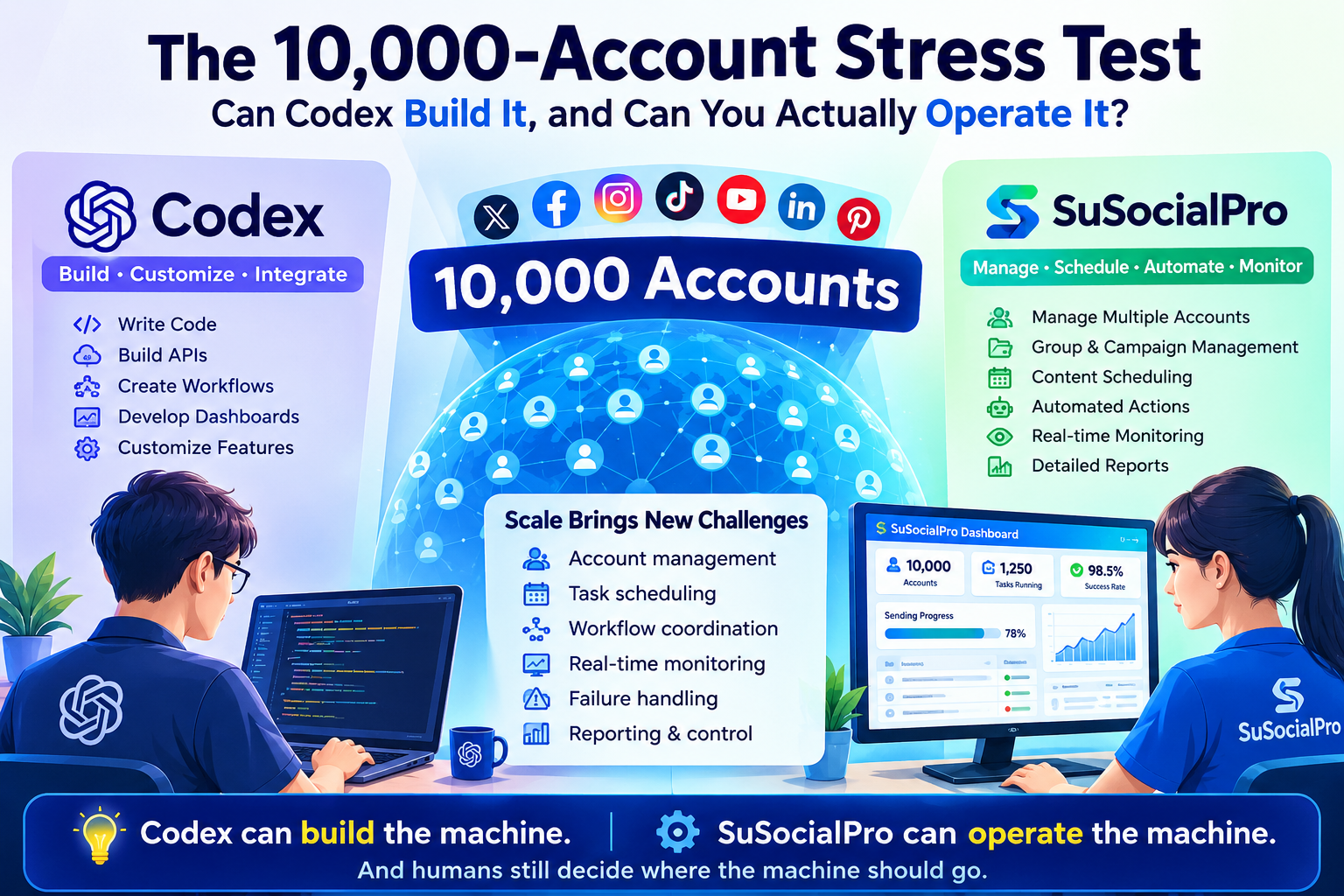
Codex can build the machine.
SuSocialPro can provide the environment to operate the machine.
And humans still decide where the machine should go.
That's what large-scale automation really looks like.