


Codex Can Build Your Social Media Automation. But Can It Run Your Social Media Operation?
Codex vs. Social Media Automation Platforms: The Hidden Cost of Building, Maintaining, and Scaling Your Own Automation
AI coding agents have changed the economics of software development.
Today, a developer can describe a workflow, ask an AI coding agent to implement it, test the result, fix errors, and continue improving the system. Codex, for example, is designed to handle software tasks end to end, including building features, refactoring code, testing, and working across longer-running development workflows.
That creates an obvious question for anyone interested in social media automation:
If AI can build the automation for me, why should I use a social media automation platform at all?
It is a reasonable question.
But there is a deeper question underneath it:
Can AI build your automation — and can that automation actually run your social media operation?
Those are two very different problems.
And as AI makes software development cheaper, the second problem may become more important, not less.
The Question Is No Longer “Can AI Build It?”
A few years ago, building custom automation required considerable technical knowledge.
You needed to understand programming, browser automation, APIs, databases, scheduling, authentication, error handling, and deployment.
AI coding agents have changed that equation.
A developer can now describe a task such as:
Find social media content matching a keyword, collect the relevant posts, and perform a predefined action.
The AI can help turn that idea into working code.
This is a genuine shift.
Codex is increasingly being used for longer-running and more complex tasks rather than simple code completion. OpenAI describes modern agentic workflows as moving toward delegated tasks that can operate for extended periods and interact with tools and environments.
So saying “AI cannot build automation” would simply be wrong.
AI can build automation.
The more interesting question is what happens after the first version works.
Building an Automation Is Only the Beginning
Imagine you spend an afternoon creating a social media automation.
It can:
- search for posts
- collect users
- like content
- publish posts
- leave comments
- follow accounts
- send messages
It works.
You have successfully solved the development problem.
But you have not necessarily solved the operational problem.
What happens tomorrow?
What happens when you have ten accounts?
What happens when you have fifty?
What happens when different accounts need different settings?
What happens when one workflow fails?
What happens when several tasks need to run at the same time?
What happens when you need to pause 30 accounts and change their configuration?
What happens when you need to know which tasks actually ran successfully?
Suddenly, the problem is no longer:
“Can I write the code?”
It becomes:
“Can I operate this system every day?”
That distinction is where many discussions about AI-built automation stop too early.
A Script, an Automation, and an Automation System Are Not the Same Thing
This distinction matters.
A script performs a task.
An automation performs that task repeatedly.
An automation system manages the entire lifecycle around that task.
For example:
Script:
Like posts containing a specific keyword.
Automation:
Search for those posts every day and like relevant content automatically.
Automation system:
Manage multiple accounts, search for content, apply filters, execute actions, schedule tasks, record results, handle failures, adjust workflows, and allow the operator to manage everything from one environment.
The third one is substantially more complicated.
And this is exactly why “AI can write the code” does not automatically mean “I no longer need an automation platform.”
AI can dramatically reduce the cost of creating the machine.
But someone still needs to operate the machine.
The Hidden Cost of Automation Is Human Attention
This is probably the most overlooked part of the discussion.
When people compare building software with buying software, they often compare development costs.
For example:
“I can build this with AI for almost nothing.”
Maybe.
But software has another cost:
attention.
If you need to repeatedly:
- check whether tasks are running
- inspect errors
- update selectors
- restart failed processes
- modify account settings
- investigate unexpected behavior
- test changes
- maintain dependencies
- monitor different workflows
then you have not eliminated manual work.
You have moved manual work.
Instead of manually operating social media, you are manually operating the software that operates social media.
That leads to a simple principle:
The hidden cost of automation is not always development. It is supervision.
An automation that requires constant supervision can still be useful.
But its value is different from an automation system designed around recurring operational work.
Social Media Automation Is a Moving Target
There is another complication.
Social media automation does not operate in a static environment.
Platforms evolve.
Interfaces change.
Workflows change.
Features are introduced and removed.
Account requirements change.
The way a browser automation interacts with a website today may not be identical six months from now.
This means that custom automation has an ongoing maintenance dimension.
AI can certainly help developers diagnose problems and modify code. That is one of its biggest advantages.
But AI-assisted maintenance is still maintenance.
You still need to:
- identify that something changed
- understand what broke
- modify the implementation
- test the modification
- deploy the change
- verify that the workflow behaves correctly
The AI can reduce the amount of human effort required.
It does not make the operational problem disappear.
The Cheaper Code Is Not Always the Cheaper Solution
This is where the traditional “build vs. buy” argument becomes more complicated.
Suppose AI reduces the development cost of a custom automation from $10,000 to $1,000.
That sounds like a massive reason to build.
But development cost is only one variable.
A more complete calculation looks like this:
Total Cost = Development + Testing + Maintenance + Operations + Troubleshooting + Opportunity Cost
The last one is particularly important.
If you are a developer building a unique internal workflow, maintaining custom automation may be completely reasonable.
If your primary business is marketing, lead generation, content distribution, or social media management, spending hours maintaining automation infrastructure may have a very different opportunity cost.
The question is therefore not simply:
“How cheaply can I build this?”
It is:
“What is the cheapest way to reliably operate this over time?”
Build vs. Buy Is Becoming the Wrong Question
AI is changing the old build-versus-buy debate.
Historically, building software was expensive.
That made platforms attractive because they eliminated development work.
Now AI can make development dramatically cheaper.
So it is tempting to conclude:
“If development is cheap, everyone should build their own software.”
But that conclusion confuses creation with operation.
The real choice is becoming:
Build
Use AI coding tools when you need:
- highly customized logic
- unique internal workflows
- specialized integrations
- experimental functionality
- complete control over implementation
Operate
Use an automation platform when you need:
- recurring workflows
- multiple accounts
- centralized management
- task scheduling
- repeatable execution
- operational visibility
- less time spent maintaining infrastructure
These two approaches do not have to compete.
In fact, they can complement each other.
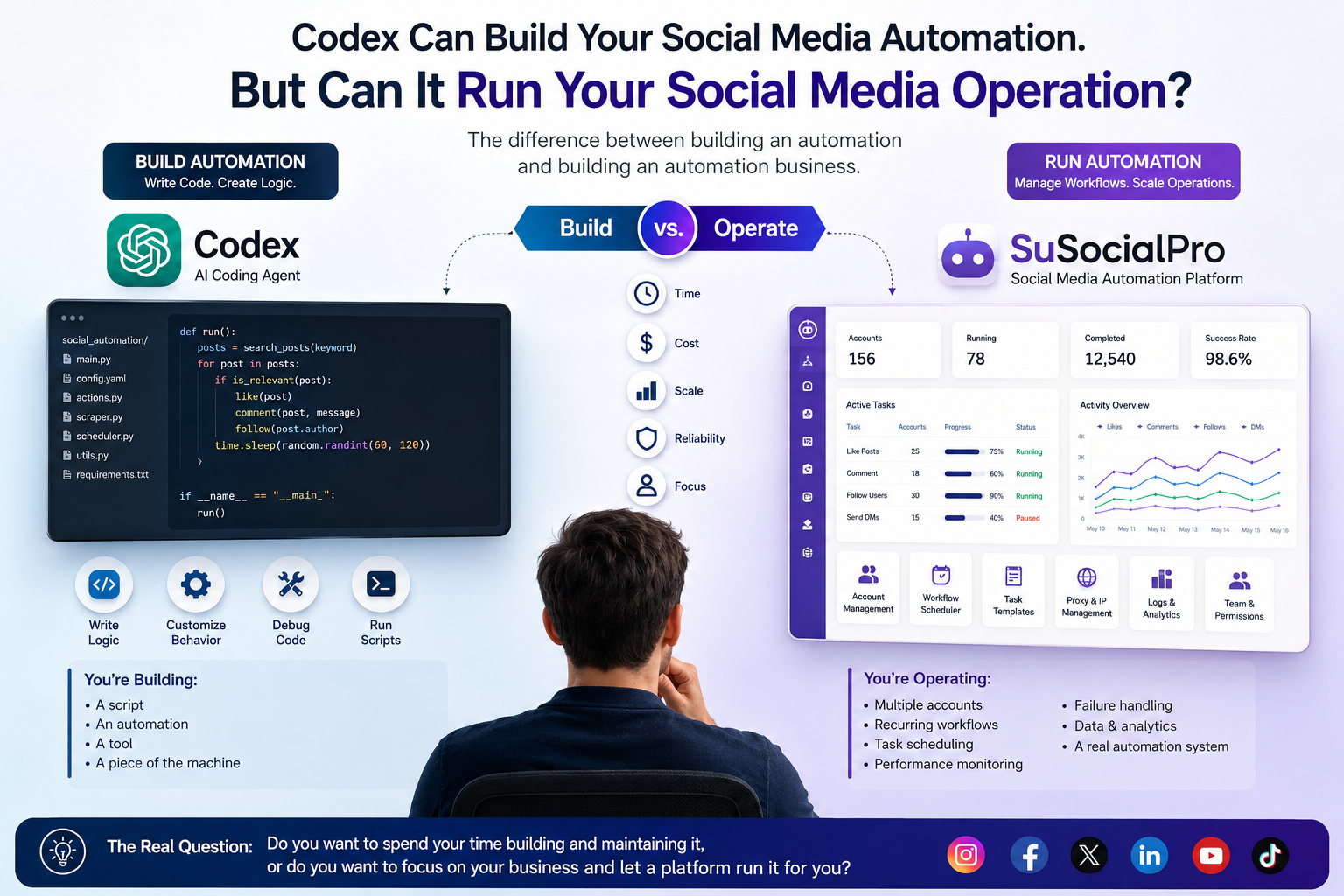
Codex and SuSocialPro Solve Different Layers
This is where the comparison becomes more interesting.
It is not particularly useful to say:
“Codex is bad for automation.”
It isn't.
And it is equally simplistic to say:
“A platform makes AI coding unnecessary.”
It doesn't.
They solve different layers.
Codex asks:
How do I build this?
SuSocialPro asks:
How do I configure, manage, and repeatedly operate my social media workflows?
That distinction is fundamental.
Codex is a development environment and coding agent.
SuSocialPro is designed around the operational side of social media automation.
One starts with code.
The other starts with workflows.
That difference becomes increasingly important as the number of accounts and tasks grows.
From Individual Actions to Repeatable Social Media Workflows
A business rarely wants automation simply because it wants to click a button automatically.
The real objective is usually a workflow.
For example:
Discover → Filter → Engage → Repeat → Measure
A marketer may want to discover social media posts related to a specific topic, identify relevant users or conversations, perform selected actions, and repeat the process across multiple accounts.
That is no longer one automation action.
It is a workflow.
And once workflows multiply, management becomes a problem of its own.
SuSocialPro is positioned around this operational layer: managing social media accounts and automating activities such as posting, commenting, liking, following, messaging, and content/user discovery.
The important point is not that one particular action can be automated.
The important point is that multiple actions can become part of a repeatable operating process.
What Changes When You Have 10, 50, or 500 Accounts?
This is where scale changes the entire discussion.
With one account, custom automation can be perfectly reasonable.
With five accounts, it may still be manageable.
But as the number of accounts grows, the number of operational variables grows with it.
Consider a simplified scenario.
You have:
10 accounts × 5 workflows = 50 recurring workflows
Now imagine:
50 accounts × 5 workflows = 250 recurring workflows
The difficulty is no longer writing one function that performs an action.
The difficulty becomes managing hundreds of combinations of:
- accounts
- workflows
- schedules
- configurations
- content
- execution states
- failures
- changes
At that point, automation becomes an orchestration problem.
And orchestration is fundamentally different from code generation.
Interestingly, this pattern is visible even in AI development itself. OpenAI's work on Symphony describes an orchestration layer that assigns coding agents to tasks and keeps them running while humans review the results. The lesson is broader than software development: as automation scales, coordination becomes a problem of its own.
The Next Competitive Advantage Is Operational Scale
If AI makes building automation easier for everyone, then custom code itself becomes less of a competitive advantage.
That does not make automation less valuable.
It changes where the value sits.
The competitive advantage moves toward:
Workflow design
Orchestration
Reliability
Account management
Operational efficiency
Data and feedback
Human oversight
This is an important shift.
When only a few companies could build automation, the ability to build it was valuable.
When AI allows many more people to build automation, simply having code is no longer enough.
The question becomes:
Who can turn automation into a reliable operating process?
The Future Is Not “AI or Automation Software”
The more interesting future is:
AI + Automation Infrastructure
AI coding agents can help create custom capabilities.
Automation platforms can provide the environment in which recurring workflows are operated.
AI can help build.
Platforms can help organize and execute.
Humans can define the strategy.
This is not necessarily a zero-sum competition.
In fact, AI may make automation platforms more important because it increases the number of workflows people are capable of creating.
More automation creates a new problem:
How do you manage all of it?
The Future of Automation Is Not No-Code. It Is No-Maintenance.
“No-code” has often been presented as the future of automation.
But that may not be the most important goal.
The bigger goal is:
Less maintenance.
Because the real frustration with automation is rarely writing the first version.
The frustration comes six weeks later.
When something breaks.
When a workflow needs to be changed.
When ten accounts need different configurations.
When 100 tasks need to be reviewed.
When the person who built the automation is no longer available.
A mature automation strategy therefore should not ask only:
“Can I automate this?”
It should ask:
“Can I operate this repeatedly without turning myself into the system administrator?”
That is a much more useful question.
So, Should You Build Your Own Social Media Automation?
Sometimes, absolutely.
If you are a developer with a highly specific technical requirement, building your own system can provide flexibility that a general platform cannot.
AI coding agents make that option more attractive than ever.
But if your primary goal is to run social media operations rather than develop software, the equation is different.
You may not need another coding project.
You may need an operating environment.
That is the role a platform such as SuSocialPro is designed to play.
The value is not simply that it can automate an individual social media action.
The value is turning social media automation from a collection of scripts into a repeatable workflow that can be configured and managed at scale.
The Question to Ask in 2026
The old question was:
“Can I build this?”
AI has made that question much easier to answer.
Increasingly, the answer is:
Probably.
The better question is:
“Do I want to spend my time operating what I built?”
And an even better one is:
“What should I build myself, and what should I delegate to automation infrastructure?”
That is the real conversation AI is creating.
The future of automation will not belong exclusively to people who can write the most code.
It will belong to people who can design the best workflows, connect the right tools, and operate those workflows reliably at scale.
AI can make automation easier to build.
The next challenge is making automation easier to operate.
And that is where dedicated social media automation platforms such as SuSocialPro have a very different role to play.