


What If Social Media Automation Is Not the Problem? What If Your Strategy Is?
We build social media automation software. So perhaps the last thing you would expect us to say is this: automation is not always the answer.
You can automate your posts.
You can automate likes.
You can automate comments.
You can automate follows.
You can manage multiple accounts.
You can even use AI to generate content and help decide what to do next.
But none of these things guarantee that your social media marketing will work.
And that leads to an uncomfortable question:
What if the problem isn't that you need more automation? What if your strategy is the problem?
This is something worth thinking about before adding another account, another automation task, or another AI tool to your workflow.
Because automation is extremely good at one thing:
Making a process repeatable.
But if the process is wrong, automation can also make the wrong process repeat faster.
Automation Does Not Fix a Bad Strategy
Imagine a business selling software to small marketing agencies.
The company decides that it needs more social media exposure.
So it creates 20 accounts.
Then it starts automating:
- 500 likes per day
- 200 follows per day
- 100 comments per day
- dozens of posts
- regular direct outreach
On paper, the operation looks impressive.
There is activity everywhere.
The dashboards are full of numbers.
But after a month, the business asks:
“Where are the customers?”
This is where the difference between activity and marketing becomes obvious.
More activity does not automatically create more demand.
More comments do not automatically create more trust.
More followers do not automatically create more customers.
And more accounts do not automatically create more revenue.
Automation can multiply activity. It cannot magically create a good strategy.
The Most Dangerous Thing About Automation
The biggest danger of automation isn't that it doesn't work.
Sometimes it works extremely well.
The danger is that it can make you believe that you are making progress simply because you are doing more.
This creates a strange situation.
Before automation:
“I don't have enough time.”
After automation:
“I'm doing everything, but nothing is really happening.”
The number of actions has increased.
The amount of work has decreased.
But the business result hasn't changed.
Why?
Because the bottleneck was never the number of actions.
The bottleneck was the quality of the actions.
Before Automating Anything, Ask Five Questions
A better social media strategy starts before the automation software is opened.
Ask:
1. Who are we trying to reach?
Not:
“Everyone who uses Instagram.”
But something more specific.
Who actually has the problem your product solves?
2. What are they talking about?
What questions are they asking?
What problems are they experiencing?
What words are they using?
What kind of posts attract their attention?
3. Where are these conversations happening?
Your customers may not be equally active on every platform.
Maybe the important conversations are happening on X.
Maybe they are concentrated in Facebook communities.
Maybe Instagram is more useful for visual products.
Maybe another platform is better for your particular audience.
The right platform matters more than the number of platforms you automate.
4. What should happen when you find them?
This is a question many automation strategies completely skip.
Suppose you find 1,000 people who might be interested in your product.
What happens next?
Do you:
- Like their content?
- Comment?
- Follow them?
- Send a message?
- Publish content they might find useful?
- Simply observe their behavior?
- Add them to another marketing workflow?
The answer depends on your strategy.
Automation cannot decide the correct answer for every business.
5. How do you measure success?
If your only metrics are:
- Actions
- Followers
- Likes
- Comments
- Posts
you may be measuring the wrong things.
A better question is:
Did the activity create meaningful attention?
And eventually:
Did that attention create conversations, leads, opportunities, or customers?
From “Do More” to “Do the Right Things”
This is where social media automation needs to mature.
The first generation of automation focused heavily on actions:
Like.
Follow.
Comment.
Post.
Repeat.
That model made sense when automation itself was the major innovation.
But automation is no longer particularly mysterious.
AI can generate code.
AI can generate content.
AI can analyze data.
AI can help design workflows.
The difficult question is becoming:
What should actually be automated?
That's a much more valuable question.
Three Levels of Social Media Automation
It helps to think about automation in three levels.
Level 1: Automating Actions
This is the simplest level.
You tell the system:
“Do this action.”
For example:
- Publish a post
- Like content
- Follow users
- Comment
- Send a supported message
- Upload content
This saves time.
And it can be useful.
But it is still relatively low-level automation.
Level 2: Automating Workflows
The next level is more powerful.
Instead of automating one action, you automate a process.
For example:
Discover → Filter → Engage → Follow Up
First, discover relevant content or users.
Then filter the results.
Then engage with selected targets.
Then continue with an appropriate follow-up workflow.
Now automation is no longer just about clicking buttons.
It is about operating a repeatable marketing process.
This is much closer to how businesses actually work.
Level 3: AI-Assisted Automation
The next stage is where things become even more interesting.
Instead of telling the system exactly what to do every time, AI can help with the reasoning around the workflow.
For example:
Which conversations are actually relevant?
Which topics are attracting potential customers?
Which content deserves attention?
Which audience segment should we focus on?
What type of content should we create?
Which workflow makes sense for this situation?
This creates a new architecture:
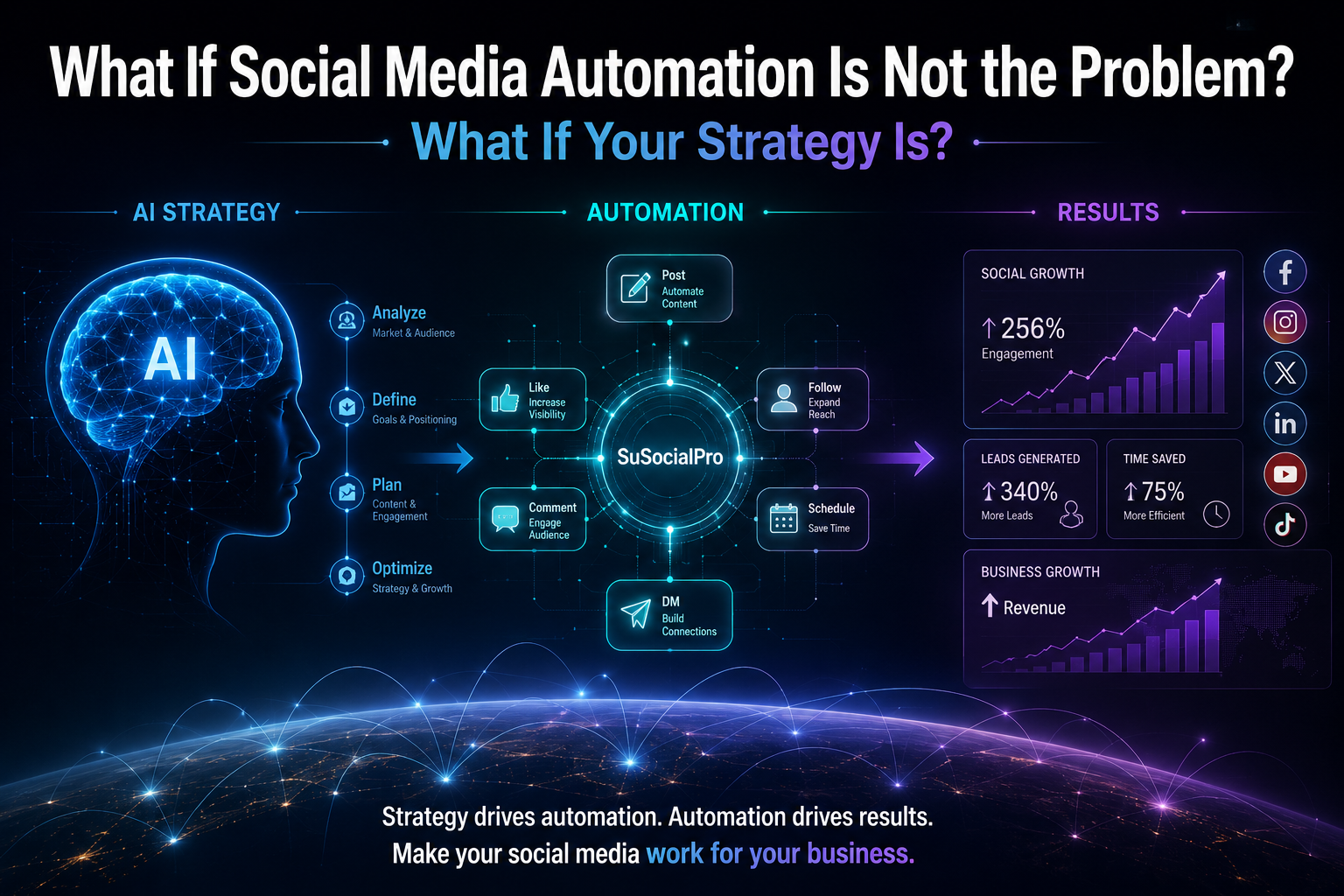
AI → Think
Automation → Execute
And that distinction is becoming increasingly important.
SuSocialPro Is Not a Replacement for Strategy
This is where we should be completely honest about SuSocialPro.
SuSocialPro cannot tell you that your business strategy is perfect.
It cannot magically turn an irrelevant product into a desirable one.
It cannot guarantee that every comment will generate a customer.
And it shouldn't pretend to.
Instead, the role of a platform like SuSocialPro is simpler:
Take a strategy that makes sense and make it easier to execute consistently.
That's an important distinction.
If your strategy is:
“Find people discussing a specific problem and engage with relevant conversations.”
SuSocialPro can help turn that idea into a repeatable workflow.
If your strategy is:
“Manage content distribution across multiple social media accounts.”
Automation can reduce the repetitive work involved.
If your strategy is:
“Use specific content and target URLs across multiple accounts.”
A structured automation platform can help organize and execute that process.
The strategy still belongs to you.
The execution can be automated.
Why Discovery May Matter More Than Automation
One of the most interesting changes in social media marketing is that businesses don't necessarily need to shout louder.
Sometimes they need to listen better.
There are already millions of conversations happening every day.
People ask questions.
People complain about problems.
People compare products.
People ask for recommendations.
People look for alternatives.
People explain what they are struggling with.
Those conversations can contain valuable signals.
The challenge is finding the relevant ones.
This is why social media automation should not be viewed only as:
“How can I publish more?”
It can also be:
“How can I discover better opportunities?”
That is a much more powerful way to think about automation.
Automation Can Help You Find the Right Conversations
Suppose you sell a social media management product.
Instead of blindly publishing another promotional post, you could look for conversations around topics such as:
- Social media management
- Multiple account management
- Social media scheduling
- Social media workflow problems
- Marketing automation
- Agency workflow challenges
The objective isn't to spam every conversation.
The objective is to discover relevant conversations.
Then you can decide:
Is this actually relevant?
Can we provide something useful?
Is there an appropriate reason to engage?
That is where automation becomes an assistant rather than a replacement for judgment.
More Automation Can Actually Create More Work
This sounds strange, but it happens all the time.
Imagine you start with five accounts.
Then you automate everything.
A month later you have:
50 accounts.
Congratulations.
You have scaled.
But now you have:
- More content
- More tasks
- More results
- More exceptions
- More accounts to organize
- More campaigns
- More data
- More decisions
You haven't eliminated complexity.
You've scaled complexity.
This is why social media scale isn't simply about adding accounts.
It requires an operating system for the work.
Scale Is Not “More Accounts”
A common assumption is:
More accounts = more reach.
Sometimes.
But scale is not simply a number.
Real scale means:
More accounts
More consistent workflows
Better content management
Better targeting
Better execution
Better measurement
Without those pieces, adding accounts can simply multiply chaos.
This is one reason platforms such as SuSocialPro become more useful as operations become more complex.
The value isn't merely that the software can perform individual social actions.
The value is having a structured environment for managing the work behind those actions.
The AI Era Makes This Even More Important
AI is changing the economics of automation.
Before AI, building custom automation required considerable programming knowledge.
Now an AI coding agent can help developers build custom tools much faster.
That is incredibly powerful.
But it creates another problem.
If everyone can build tools, then the question becomes:
Which tools should we build?
And:
Which tools should we simply use?
A developer may decide to build everything.
A marketing team may reasonably decide that building and maintaining an entire social media automation infrastructure is not the best use of its time.
Both decisions can be correct.
The right choice depends on the problem.
Codex Can Build the Machine. But Who Operates It?
This is where the previous discussion about AI coding becomes relevant.
Imagine using Codex to build your own social media automation system.
You might be able to create exactly what you want.
That is a huge advantage.
But after building it, you still need to operate it.
You need to:
- Manage accounts
- Configure tasks
- Maintain workflows
- Monitor execution
- Handle changes
- Fix problems
- Update the system
- Train users
- Review results
At some point, the question becomes:
Do I want to run a marketing operation, or do I want to maintain the software behind my marketing operation?
There is no universally correct answer.
But it is an important question.
The Best Automation Strategy Is Usually Selective
The goal should not be:
Automate everything.
A better goal is:
Automate what is repetitive. Keep humans responsible for what requires judgment.
For example:
Automate
- Repetitive publishing
- Repetitive account tasks
- Data collection
- Workflow execution
- Task scheduling
- Repeated interactions where appropriate
- Routine operational processes
Keep human judgment
- Brand positioning
- Campaign strategy
- Customer understanding
- Content direction
- Sensitive conversations
- Business decisions
- Measuring whether the strategy is actually working
This division is much healthier than trying to replace the entire marketing process with automation.
Automation Should Amplify Good Marketing
Think of automation like a multiplier.
If your strategy is good:
Good strategy × automation = more consistent execution
If your strategy is bad:
Bad strategy × automation = more consistent mistakes
That's why the first question should never be:
“How many actions can I automate?”
The better question is:
“Which repeatable process is actually helping my business?”
Once you know that, automation becomes much more useful.
So What Is SuSocialPro Actually For?
At its best, SuSocialPro should not be viewed as a machine that replaces your social media strategy.
Think of it as an execution layer.
You decide:
Who to reach.
What to say.
Where to engage.
What workflow makes sense.
SuSocialPro helps with:
How to execute that workflow repeatedly across your social media operation.
That's a much more realistic promise.
And, in our opinion, a much more valuable one.
The Future Is Not “Human vs Automation”
The conversation around AI often creates a false choice:
Humans or machines?
That's probably the wrong question.
A better model is:
Human
Defines the objective.
↓
AI
Helps understand data, generate ideas, and improve decisions.
↓
Automation Platform
Executes repeatable workflows.
↓
Human
Reviews results and improves the strategy.
This creates a feedback loop:
Strategy → AI → Automation → Results → Learning → Better Strategy
That is where social media automation becomes genuinely interesting.
The Most Important Automation Question
Before adding another account, another task, or another AI tool, ask yourself:
If I automated this process 10 times more, would I actually get 10 times more value?
If the answer is no, don't automate it yet.
Fix the process first.
Find the right audience.
Improve the content.
Understand the customer.
Choose the right platform.
Define what success actually means.
Then automate.
Because automation should not hide a weak strategy.
It should amplify a strong one.
Final Thought
We are entering a period where almost anyone can build software with the help of AI.
That is exciting.
It also means that software itself is becoming less of a competitive advantage.
The harder question is becoming:
What should the software actually do?
In social media marketing, that question matters enormously.
You can automate 1,000 actions.
But if you are talking to the wrong people, those 1,000 actions don't mean much.
You can manage 100 accounts.
But if none of them has a clear purpose, 100 accounts are just 100 more problems.
You can generate thousands of pieces of content.
But if nobody cares about the topic, more content won't solve the problem.
So perhaps the future of social media automation isn't about automating more.
Perhaps it is about automating better.
And that is where SuSocialPro fits.
Not as a replacement for your strategy.
Not as a magic button for growth.
But as a way to turn a good social media strategy into a repeatable, scalable workflow.
Because the goal of automation was never to make businesses do more meaningless actions.
The goal was to give people more time to do the things that actually matter.