


How to Bulk Post on Facebook, Instagram, TikTok, Pinterest & More Without Doing Everything Manually
If you manage more than one social media account, you have probably searched for how to bulk post.
Maybe you have a week of content ready, but publishing it means opening Facebook, Instagram, TikTok, Pinterest, and other platforms one by one.
Then you have to repeat the same process again tomorrow.
And again next week.
The problem is not creating content.
The problem is turning one piece of content into a repeatable publishing workflow across multiple social platforms.
That is why searches such as “how to bulk post on Facebook,” “how to bulk post on Instagram,” “how to bulk post on TikTok,” “how to bulk post on Pinterest,” and even “how to bulk post in Facebook groups” continue to be useful questions for marketers, agencies, creators, and businesses.
The better question is not simply:
How can I publish more posts?
It is:
How can I manage bulk social media publishing without turning social media management into a full-time manual job?
This is where social media automation becomes much more interesting.
What Does “Bulk Posting” Actually Mean?
Bulk posting can mean several different things.
For some users, it means preparing 20 posts and publishing them over several days.
For others, it means publishing similar content across multiple social networks.
For agencies, it can mean managing dozens of client accounts while keeping each account's content organized.
And for larger operations, bulk posting can become part of a much bigger workflow:
Create → Organize → Schedule → Publish → Engage → Analyze → Repeat
This distinction matters.
A simple scheduler solves only part of the problem.
A more complete social media automation workflow looks at what happens before and after publishing, not just the publishing button itself.
How to Bulk Post on Facebook
Facebook is one of the first platforms people think about when searching for how to bulk post on Facebook.
If you only have one Facebook page and publish occasionally, manual posting may be enough.
But the workflow changes when you manage:
- Multiple Facebook accounts
- Multiple Facebook pages
- Multiple brands
- Multiple campaigns
- Client accounts
- Large content libraries
Imagine preparing 50 pieces of content.
Manually publishing them means repeatedly switching accounts, opening publishing interfaces, uploading content, writing captions, and repeating the same steps.
The content itself may have taken only a few hours to create.
The publishing process can consume much more time than expected.
The real problem isn't Facebook posting
It is repetition.
A good bulk posting workflow should reduce repetitive actions while keeping your content organized.
This is one reason social media automation tools can be useful for marketers managing multiple accounts.
Instead of treating every post as an individual task, you can think of publishing as a workflow.
How to Bulk Post on Instagram
The search “how to bulk post on Instagram” usually comes from a similar problem.
Instagram content is often created in batches.
For example, a business might prepare:
- 10 product posts
- 20 promotional images
- 30 educational posts
- Several short videos
- A month of campaign content
Creating this content in advance is efficient.
But manually publishing every item can destroy that efficiency.
This is especially true when an agency manages Instagram accounts for multiple clients.
Bulk posting is really about reducing context switching
Consider what happens when publishing manually:
- Open an account.
- Find the content.
- Upload the media.
- Write or paste the caption.
- Configure the post.
- Publish.
- Switch to another account.
- Repeat.
None of these actions are particularly difficult.
The problem is that you have to perform them hundreds of times.
Automation changes the equation by turning repetitive publishing actions into a system.
That is a much more scalable way to think about Instagram management.
How to Bulk Post on TikTok
TikTok introduces another challenge because short-form video content requires more than simply uploading a file.
A typical workflow may involve:
- Selecting the video
- Writing a caption
- Preparing hashtags
- Choosing publishing options
- Managing multiple accounts
- Repeating the process for another video
If you operate several TikTok accounts, the number of repetitive actions can grow quickly.
This is why how to bulk post on TikTok is becoming a practical workflow question rather than simply a technical question.
The objective should not be to publish everything at once.
The objective is to build a system where content can be prepared in batches and executed consistently.
How to Bulk Post on Pinterest
Pinterest is another platform where content can be produced in batches.
For example, a website may create dozens of visual assets for different:
- Blog posts
- Product pages
- Landing pages
- Guides
- Seasonal campaigns
Publishing each pin individually creates the same repetitive problem.
A better workflow starts with a content library.
Instead of thinking:
“I need to publish a pin.”
Think:
“I have 100 pieces of content that need to move through my publishing workflow.”
That small change in mindset can make a major difference when managing social media at scale.
How to Bulk Post in Facebook Groups
“How to bulk post in Facebook groups” is a particularly interesting search because group posting is different from managing a single page.
Groups can have their own rules, approval processes, audiences, and posting restrictions.
That means bulk posting should not simply mean:
Copy the same message and send it everywhere.
A better strategy is to build a controlled workflow.
For example:
Content → Relevant group → Appropriate message → Publish → Monitor response
The goal is not maximum posting volume.
The goal is relevant distribution.
If you participate in multiple communities, automation can help reduce repetitive work, but human judgment still matters.
You need to understand which communities are relevant, what type of content belongs there, and how frequently you should participate.
Automation should remove repetitive operations—not replace strategy.
How to Bulk Post Across Multiple Social Media Platforms
This is where the idea of bulk posting becomes much more powerful.
Suppose you have one campaign.
The campaign includes:
- A Facebook post
- An Instagram post
- A TikTok video
- Pinterest content
- X content
- Other social media updates
Without a system, each platform becomes a separate task.
With a structured workflow, the campaign becomes a single content operation with multiple distribution channels.
The difference looks like this:
Manual workflow
Content
↓
Facebook
↓
Instagram
↓
TikTok
↓
Pinterest
↓
X
↓
Repeat tomorrow
Automated workflow
Content Library
↓
Campaign Workflow
↓
Multiple Social Accounts
↓
Scheduled / Automated Actions
The second model is much easier to scale.
Bulk Posting Is Not the Same as Spam
This distinction is important.
When people hear “bulk posting,” they sometimes immediately think about posting the same message everywhere as quickly as possible.
That is not a good social media strategy.
Scale does not mean sacrificing relevance.
A professional bulk posting system should still consider:
- Content quality
- Audience relevance
- Posting frequency
- Platform differences
- Account limits
- Community rules
- Engagement
- Timing
- Content variation
The purpose of automation is to reduce repetitive work so that marketers can spend more time on decisions that actually require human thinking.
What About Bulk Deleting Posts on Facebook?
Another search visible in Google's suggestions is:
“how to bulk delete posts on Facebook”
This reveals an important part of social media management that is often overlooked.
Publishing is only one side of account management.
Sometimes you also need to clean up old content.
For example, a business may have:
- Old promotional posts
- Outdated campaigns
- Expired offers
- Incorrect information
- Content from a previous brand strategy
Managing hundreds or thousands of old posts manually can be extremely inefficient.
That is why content lifecycle management should be considered part of social media automation.
Your workflow should not end when content is published.
It should also answer:
When should this content remain active?
When should it be reviewed?
When should it be removed or replaced?
What About Bulk Deleting Posts on Instagram?
The same principle applies to Instagram.
A brand that has been active for years can accumulate a large amount of old content.
Some posts may still be valuable.
Others may no longer represent the brand.
So the question “how to bulk delete posts on Instagram” is really part of a broader social media management problem:
How do you maintain a large social media account without manually reviewing everything one item at a time?
The answer is not necessarily “delete everything.”
Instead, build a content management process.
Audit → Identify → Decide → Remove / Keep → Update strategy
Automation can help with repetitive operations, while the final decision remains a strategic one.
Why Traditional Social Media Scheduling Is Not Always Enough
Many social media tools focus heavily on scheduling.
Scheduling is useful.
But managing social media at scale often involves much more than:
“Publish this post at 9:00 AM.”
You may also need to manage:
- Multiple accounts
- Multiple platforms
- Likes
- Comments
- Follows and unfollows
- Direct messages
- Content publishing
- Account activity
- Video uploads
- Content distribution
- Repetitive engagement tasks
This is where social media automation becomes broader than traditional scheduling.
You are no longer simply asking:
“When should this post be published?”
You are asking:
“Which repetitive parts of my social media workflow can be systemized?”
That is a much bigger question.
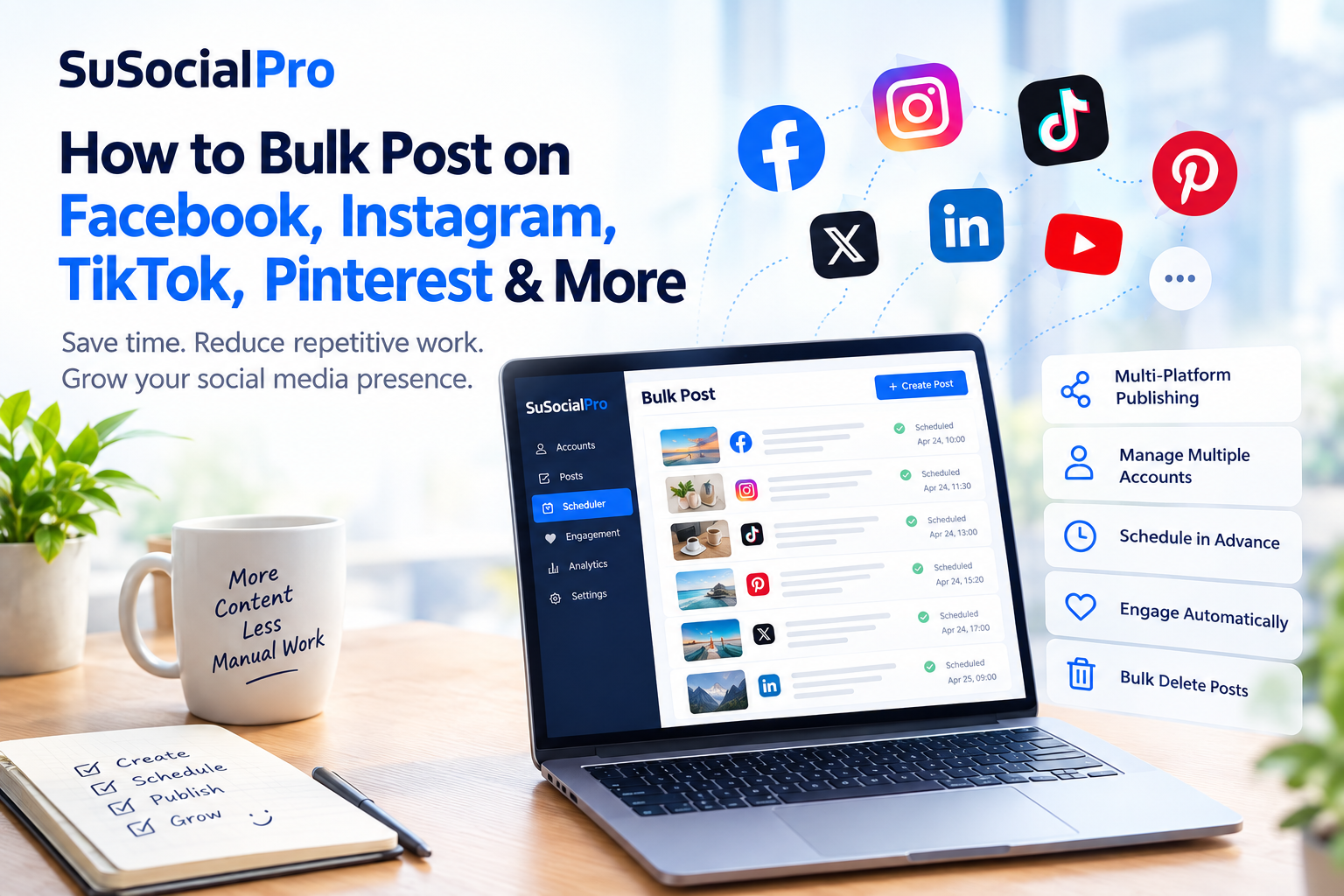
Where SuSocialPro Fits Into the Bulk Posting Workflow
This is exactly the type of problem SuSocialPro is designed to address.
SuSocialPro is not simply a calendar for scheduling posts.
It is built around the idea that managing social media at scale involves many repetitive actions.
Depending on the workflow, marketers can use it to automate activities such as:
- Social media posting
- Content distribution
- Likes
- Comments
- Follows and unfollows
- Direct messaging
- Video uploads
- Multi-account management
- Platform-specific social media workflows
The important concept is centralized automation.
Instead of treating every social media account as a completely separate manual project, you can build a repeatable workflow around your accounts.
From “How to Bulk Post” to “How to Build a Social Media System”
This is the bigger lesson behind all those Google searches.
Someone searching:
how to bulk post
may initially think they need a button.
But as their social media operation grows, they usually discover that the real problem is much larger.
They need a system.
A system that can handle:
Content
↓
Multiple Accounts
↓
Multiple Platforms
↓
Publishing
↓
Engagement
↓
Account Management
↓
Content Maintenance
And that is why the conversation should move beyond bulk posting.
How Agencies Can Use Bulk Social Media Automation
For agencies, the difference becomes even more obvious.
Imagine an agency managing 30 clients.
Each client has three social media accounts.
That is potentially:
30 × 3 = 90 accounts
If every task is performed manually, even simple actions become expensive in terms of employee time.
The agency may eventually hire more people just to perform repetitive operations.
But adding people does not necessarily solve the underlying problem.
It can simply create a larger manual system.
Automation offers another approach:
More accounts → Better workflows → Less repetitive work
This allows teams to spend more time on:
- Strategy
- Creative work
- Client communication
- Analytics
- Campaign planning
- Optimization
Instead of constantly clicking buttons.
The Real Value of Bulk Posting Is Not “Posting More”
This is perhaps the most important point.
You do not automate social media because you want to sit around and publish 1,000 posts.
You automate because repetitive work has an opportunity cost.
Every hour spent manually publishing, liking, commenting, following, uploading, or managing accounts is an hour that cannot be spent on higher-value work.
So the real equation is:
Automation ≠ More Work
Automation = Less Repetitive Work
And that creates room for:
More Strategy + More Creativity + Better Scaling
A Better Way to Think About Social Media Automation
Instead of asking:
How do I bulk post on Facebook?
Ask:
How can I create one efficient workflow for managing my Facebook accounts?
Instead of:
How do I bulk post on Instagram?
Ask:
How can I reduce repetitive Instagram management?
Instead of:
How do I bulk post on TikTok?
Ask:
How can I manage TikTok content at scale without multiplying manual work?
And instead of:
How do I bulk delete posts?
Ask:
How can I manage the entire lifecycle of my social media content?
These are better questions because they lead to systems rather than isolated tricks.
Final Thoughts: Bulk Posting Is Only the Beginning
The Google searches “how to bulk post,” “how to bulk post on Facebook,” “how to bulk post on Instagram,” “how to bulk post on TikTok,” “how to bulk post on Pinterest,” “how to bulk post in Facebook groups,” “how to bulk delete posts on Facebook,” and “how to bulk delete posts on Instagram” all point toward the same underlying problem.
Social media becomes difficult when every small action has to be repeated manually.
Publishing is one example.
Engagement is another.
Account management is another.
Content maintenance is another.
The solution is not simply to do more work faster.
It is to design a better workflow.
That is where SuSocialPro can fit.
If you are managing multiple social media accounts, running campaigns for clients, or simply tired of repeating the same social media tasks every day, SuSocialPro can help turn repetitive social media operations into a more scalable automation workflow.
Bulk posting is not the end goal.
Building a social media system that can scale without multiplying manual work is.