


Instagram Marketing in 2026: How to Build a Scalable Content and Engagement System
Instagram marketing is no longer simply about posting attractive photos and waiting for followers to arrive.
For businesses, creators, agencies, and marketers, the real challenge is consistency. You need to continuously research content ideas, create posts, write captions, publish at the right time, respond to your audience, monitor performance, and often manage more than one account at the same time.
This creates a problem that is easy to overlook:
Instagram marketing is increasingly becoming a workflow problem rather than a content problem.
You may already have good content. You may understand your audience. You may even have a solid Instagram marketing strategy. But if executing that strategy requires hours of repetitive manual work every day, maintaining consistency becomes difficult.
This is where a structured Instagram marketing system—and the right level of automation—can make a meaningful difference.
What Is Instagram Marketing?
Instagram marketing is the process of using Instagram to build brand awareness, attract an audience, communicate with customers, generate traffic, and support business growth.
It can include:
- Organic content publishing
- Reels and short-form video
- Stories
- Community engagement
- Comment management
- Influencer collaborations
- Product promotion
- User-generated content
- Content scheduling
- Performance analysis
- Social media automation
However, successful Instagram marketing is not simply about doing more.
The goal is to build a system that allows you to consistently do the right things.
Publishing 30 random posts is not necessarily better than publishing 10 strategically planned posts. Getting thousands of views on one piece of content does not automatically create a successful marketing channel.
The real objective is to create a repeatable process in which content, publishing, engagement, and analysis continuously support one another.
Why Instagram Marketing Has Become a Workflow Problem
Imagine managing one Instagram account manually.
You might spend time researching topics, creating visuals, writing captions, adding hashtags, publishing posts, checking comments, replying to users, and reviewing analytics.
For one account, this may be manageable.
Now imagine managing five, ten, or twenty accounts.
The problem changes completely.
The difficulty is no longer:
"Can I create an Instagram post?"
It becomes:
"Can I execute the same marketing process consistently across multiple accounts without spending my entire day on repetitive tasks?"
This distinction is extremely important.
A good Instagram marketing strategy can fail because of poor execution. Content may be published inconsistently. Important tasks may be forgotten. Engagement may happen too late. Campaigns may become difficult to coordinate.
This is why marketers increasingly need to think about Instagram as a system of repeatable workflows.
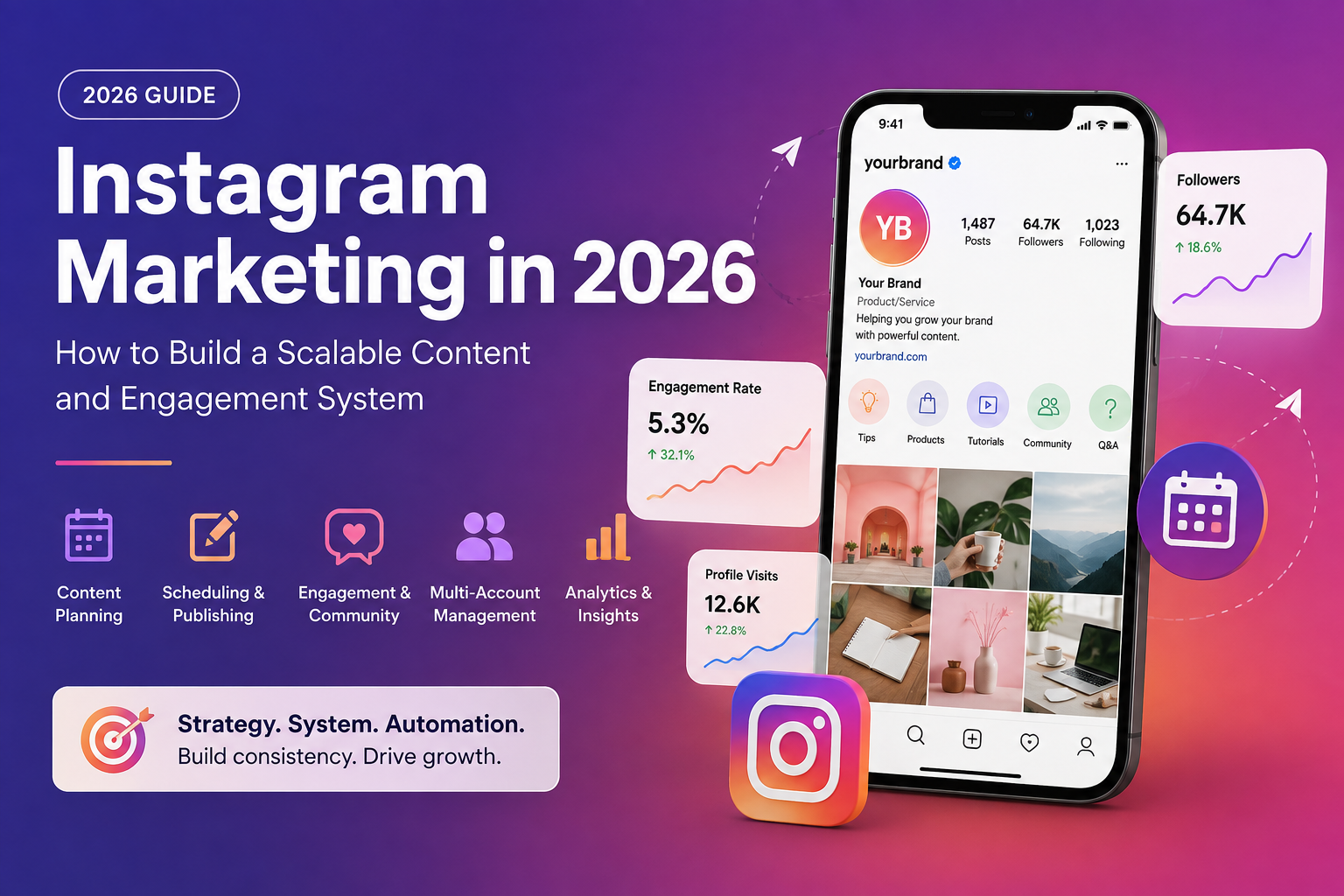
The Six Parts of a Scalable Instagram Marketing System
A scalable Instagram strategy can be divided into six connected areas:
- Content planning
- Content production
- Publishing and scheduling
- Audience engagement
- Multi-account management
- Performance analysis
Automation should support these areas—not replace the strategy behind them.
1. Content Planning Comes Before Automation
One of the biggest mistakes in Instagram marketing is trying to automate a process that has not been properly designed.
Automation cannot solve a weak content strategy.
Before thinking about scheduling or automation, determine:
- Who is your target audience?
- What problems do they have?
- What topics are relevant to them?
- What type of content do they engage with?
- What action should each post encourage?
- What role does Instagram play in your overall marketing funnel?
A useful content strategy usually contains several content pillars.
For example, a software company might use:
- Educational content
- Industry insights
- Product use cases
- Customer problems
- Tutorials
- Behind-the-scenes content
- Case studies
- Promotional content
The purpose of content pillars is not simply to make the account look active.
They create consistency.
When you already know what subjects you want to cover, creating content becomes much easier. More importantly, you can build a publishing workflow around those subjects.
2. Content Production Should Become Repeatable
The next challenge is content production.
Many marketers treat every Instagram post as a completely new project. This creates unnecessary friction.
A better approach is to create repeatable content formats.
For example:
Educational post
Problem → Explanation → Example → Practical advice
Product post
Problem → Solution → Feature → Benefit → Call to action
Industry insight
Observation → Why it matters → Practical implication
Tutorial
Goal → Steps → Result
Once these structures become reusable, content production becomes more efficient.
This is especially valuable when AI tools are introduced into the workflow. AI can help generate ideas, draft captions, summarize information, and create variations, but human judgment should remain responsible for the overall strategy, positioning, and quality.
The goal is not to produce the maximum amount of content.
The goal is to produce useful content consistently.
3. Scheduling Turns Content Into a System
Consistency is one of the most difficult parts of social media marketing.
You may have ten good posts ready today, but that does not mean you should publish all ten immediately.
A better approach is to organize content into a publishing schedule.
For example:
- Monday — Educational content
- Tuesday — Industry insight
- Wednesday — Short-form video
- Thursday — Tutorial
- Friday — Product or case study
- Weekend — Community-focused content
The exact schedule depends on the audience and business. There is no universal posting frequency that guarantees success.
What matters is creating a sustainable rhythm.
This is where Instagram scheduling tools become useful.
Instead of manually logging into an account every time something needs to be published, marketers can prepare content in advance and organize publishing tasks into a structured workflow.
Scheduling does not make content better.
It makes consistent execution easier.
That distinction matters.
4. Engagement Is More Than Posting Content
Another common mistake is treating Instagram as a one-way publishing platform.
You publish something.
Someone comments.
You publish another post.
That is not a complete social media strategy.
Instagram is a social network, so audience interaction matters.
Engagement can include:
- Responding to comments
- Participating in relevant conversations
- Monitoring audience reactions
- Identifying recurring questions
- Learning from customer feedback
- Maintaining an active presence
This also creates a valuable feedback loop.
Your audience tells you what they care about through questions, comments, reactions, and content behavior.
Those signals can then influence your next round of content.
In other words:
Content creates conversations, conversations create insights, and insights improve future content.
That is much more valuable than simply trying to increase the number of posts published.
5. Managing Multiple Instagram Accounts Requires a Different Approach
Managing one account and managing multiple accounts are fundamentally different jobs.
A single account may allow you to work manually without too much difficulty.
But agencies, marketers, businesses, and creators may need to manage multiple brands, projects, niches, or client accounts.
At that point, several problems appear:
- Different content calendars
- Different publishing schedules
- Different audiences
- Different content strategies
- Different engagement requirements
- Repetitive administrative work
- Difficulty keeping track of tasks
This is where centralized social media management becomes increasingly useful.
Instead of treating every account as an isolated workspace, you can think of your accounts as part of one larger operational system.
The objective is not to make every account behave identically.
The objective is to make the management process more organized while keeping each account's content and strategy unique.
6. Analytics Should Influence the Next Decision
Posting content without reviewing the results is another common weakness.
The purpose of analytics is not simply to produce attractive numbers.
Analytics should help answer questions such as:
- Which topics generate the most engagement?
- Which formats attract attention?
- Which posts generate profile visits?
- Which content produces meaningful interactions?
- What does the audience ignore?
- Which content should be repeated?
- Which content should be changed?
This creates a continuous cycle:
Plan → Create → Publish → Engage → Measure → Improve
The important part is the final step.
If analytics do not change what you do next, you are collecting data rather than using it.
What Is Instagram Automation?
Instagram automation generally refers to using software to reduce or manage repetitive social media tasks.
Depending on the platform and workflow, this may include:
- Content scheduling
- Publishing management
- Account organization
- Repetitive workflow management
- Engagement-related workflows
- Multi-account management
- Content planning
- Reporting and monitoring
However, automation should not be confused with strategy.
A tool can help you execute a process.
It cannot automatically determine what your brand should say, who your ideal customers are, or why a particular piece of content matters.
That is why a better philosophy is:
Strategy decides what should happen. Automation helps make sure it happens consistently.
Manual Instagram Management vs. Automation
Manual management still has an important place in Instagram marketing.
For example, genuine conversations, creative decisions, campaign strategy, and customer relationships often require human judgment.
Automation becomes more valuable when the task is:
- Repetitive
- Predictable
- Time-consuming
- Easy to standardize
- Performed frequently
This creates a useful division of labor.
Humans should focus on:
- Strategy
- Creativity
- Brand voice
- Relationships
- Decision-making
- Customer understanding
Software can help with:
- Organization
- Scheduling
- Repetitive workflows
- Multi-account operations
- Routine management tasks
The strongest approach is therefore not human versus automation.
It is human strategy + software-assisted execution.
How SuSocialPro Fits Into an Instagram Marketing Workflow
For marketers who need a more structured approach to social media management, SuSocialPro is designed to help organize and automate repetitive social media workflows.
Instead of treating Instagram as a collection of individual manual tasks, SuSocialPro can be used as part of a broader social media management process.
This is particularly useful when managing multiple social media accounts or when maintaining a consistent publishing workflow becomes difficult.
The value is not simply in "automating Instagram."
The bigger value is reducing the operational workload surrounding social media marketing.
A marketer can spend less time repeatedly performing routine tasks and more time thinking about:
- What content should be created?
- Which audience should be targeted?
- What message should the brand communicate?
- Which campaign deserves more attention?
- What does the audience actually want?
That is the real purpose of automation.
Automation Should Not Mean More Spam
There is an important distinction between automation and low-quality activity.
Using software to organize content and reduce repetitive work is very different from trying to generate meaningless activity at scale.
More actions do not automatically mean more growth.
In fact, excessive automation without a strategy can create the opposite result:
- Repetitive content
- Poor audience experience
- Irrelevant interactions
- Inconsistent brand voice
- Low-quality engagement
A scalable Instagram strategy should therefore prioritize quality, relevance, consistency, and control.
Automation should support those principles.
It should never become an excuse to remove them.
How to Build a Better Instagram Automation Workflow
A practical workflow might look like this:
Step 1: Define your audience
Understand who you are trying to reach and what they care about.
Step 2: Create content pillars
Choose several recurring topics that support your marketing goals.
Step 3: Build reusable content formats
Create templates for educational posts, tutorials, promotional posts, insights, and other recurring formats.
Step 4: Prepare content in batches
Instead of creating and publishing one post at a time, prepare content in groups.
Step 5: Organize the publishing schedule
Determine when each piece of content should be published.
Step 6: Automate repetitive workflows
Use appropriate social media management tools to reduce repetitive operational work.
Step 7: Monitor engagement
Pay attention to how people respond rather than focusing only on publishing volume.
Step 8: Analyze performance
Identify what worked, what failed, and what deserves another test.
Step 9: Improve the next content cycle
Use the information collected from the previous cycle to improve the next one.
This creates a system rather than a collection of disconnected actions.
Common Instagram Marketing Mistakes
Mistake 1: Posting Without a Strategy
Being active does not necessarily mean being effective.
Mistake 2: Focusing Only on Follower Growth
Followers are useful, but they are not the only indicator of marketing performance.
Reach, engagement, profile visits, leads, conversions, and audience quality may be more meaningful depending on your objective.
Mistake 3: Automating Everything
Not every task should be automated.
Human interaction and strategic decision-making remain important.
Mistake 4: Using the Same Content Everywhere
Different platforms have different audiences and content behaviors.
A piece of content may need to be adapted rather than simply copied.
Mistake 5: Ignoring Analytics
Without reviewing results, it becomes difficult to know whether your strategy is actually improving.
Mistake 6: Confusing Activity With Progress
Publishing more posts, performing more actions, or managing more accounts does not automatically create better marketing.
The real question is:
Are your activities producing better outcomes?
Is Instagram Automation Safe?
The answer depends on what is being automated and how the workflow is designed.
Automation should be used carefully and responsibly. Marketers should understand Instagram's current rules and avoid workflows that create spam, misleading activity, or unnatural behavior.
The safest approach is to use automation primarily to improve organization, consistency, scheduling, and operational efficiency while maintaining human oversight.
Automation should make your workflow more manageable—not remove your responsibility for what your accounts do.
How to Manage Multiple Instagram Accounts More Efficiently
If you manage multiple accounts, the first step is not necessarily buying more tools.
It is creating a clear operating system.
For each account, define:
- Target audience
- Content pillars
- Brand voice
- Publishing frequency
- Content formats
- Engagement responsibilities
- Performance metrics
- Workflow rules
Then separate account-specific strategy from shared operational processes.
For example, ten accounts may have ten different content strategies, but the process for organizing content, scheduling posts, reviewing performance, and tracking tasks can be standardized.
This is where social media management software can provide significant operational value.
The Future of Instagram Marketing Is Not "More Automation"
The future of Instagram marketing is not about automating every possible action.
It is about building better systems.
As content production becomes faster through AI and other technologies, the advantage will increasingly come from how well marketers organize information, understand their audiences, test ideas, and turn successful processes into repeatable workflows.
The competitive advantage is therefore shifting.
It is moving from:
"Who can post the most?"
to:
"Who can build the most effective and sustainable marketing system?"
That is a much more important question.
A strong Instagram presence is not created by one viral post.
It is created through hundreds of small decisions made consistently over time.
Frequently Asked Questions
What is Instagram marketing?
Instagram marketing is the use of Instagram to build brand awareness, reach target audiences, engage with customers, distribute content, generate traffic, and support broader business objectives.
What is an Instagram marketing strategy?
An Instagram marketing strategy defines your target audience, content pillars, publishing approach, engagement methods, goals, and measurement framework.
What is Instagram automation?
Instagram automation uses software to assist with repetitive or structured social media management tasks, such as scheduling and organizing publishing workflows.
Can Instagram automation replace a social media manager?
No. Automation can reduce repetitive operational work, but strategy, creativity, brand decisions, audience understanding, and meaningful communication still require human judgment.
How can I manage multiple Instagram accounts?
A combination of clear account-level strategies, centralized content planning, scheduling, workflow management, analytics, and appropriate social media management software can make multi-account management significantly more efficient.
How often should I post on Instagram?
There is no universal number that works for every account. A sustainable publishing schedule that your team can maintain consistently is generally more useful than chasing an arbitrary posting frequency.
Final Thoughts
Instagram marketing is often described as a content game.
But for businesses and marketers managing social media at scale, that description is incomplete.
Content is only one part of the process.
The bigger challenge is building a system that connects strategy, content, publishing, engagement, management, and analysis.
The best automation strategy is therefore not the one that performs the most actions.
It is the one that removes unnecessary repetitive work while giving marketers more time to focus on the decisions that actually matter.
Create better content. Build better workflows. Measure the results. Improve continuously.
And when Instagram marketing grows beyond what can be comfortably managed by hand, the right social media management system can turn a collection of repetitive tasks into a scalable, repeatable process.