


How to Find Potential Customers on Instagram Without Spending Hours Searching Manually
If you run a business, you have probably heard the same advice many times:
“Go to Instagram and find your customers.”
Sounds easy, right?
Until you actually try it.
You open Instagram. You search for a few keywords. You scroll through posts. You open profiles. You check what people are talking about. You go back to the search page and start again.
After an hour, you may have found a few interesting accounts.
Then you realize something:
You have spent an hour looking for customers instead of actually marketing to them.
This is a problem that many small businesses, marketers, and agencies face when they try to use Instagram for customer acquisition.
And this is where Instagram marketing automation becomes interesting.
The Problem Is Not That Instagram Has Too Few Potential Customers
Let's imagine a marketer named Michael Carter.
Michael runs a small digital marketing agency. His ideal customers are small businesses that want to improve their social media marketing.
He knows Instagram is full of these businesses.
So he starts searching.
He searches for:
- small business marketing
- Instagram marketing
- Shopify store
- e-commerce business
- social media strategy
- online store
- digital marketing
At first, everything looks promising.
He finds hundreds of posts.
But then comes the difficult part.
Which people are actually potential customers?
A person who uses the hashtag #marketing may be a marketer.
A person who follows a marketing account may simply be interested in the topic.
A person who posts about their business may already have a marketing team.
And someone asking:
“How can I get more customers from Instagram?”
could be much more interesting.
That is the difference between finding people and finding potential customers.
Don't Just Search for People. Search for Conversations.
This is probably one of the most important ideas in Instagram lead generation.
A potential customer does not always look like a potential customer from their profile.
They may not write:
“I need a marketing agency.”
Instead, they might post:
“Why is my Instagram engagement dropping?”
Or:
“What is the best way to promote my online store?”
Or:
“I'm getting views but no sales.”
These conversations can tell you much more about someone's needs than their follower count.
This is why I think Instagram customer acquisition should not be reduced to simply collecting usernames.
The real opportunity is discovering relevant conversations.
Instagram is increasingly used for brand discovery and customer research, which means businesses can find both audiences and commercial intent through the content people interact with.
Why Manual Instagram Customer Research Becomes a Problem
Let's go back to Michael.
On Monday, he searches for potential customers for one hour.
On Tuesday, he does it again.
On Wednesday, again.
Soon he realizes that his process looks like this:
Search → Open post → Check profile → Decide → Record → Repeat
There is nothing technically difficult about this process.
The problem is repetition.
If you have to repeat the same actions hundreds or thousands of times, the process becomes difficult to scale.
And there is another problem.
Human attention is expensive.
If Michael spends three hours every day searching Instagram manually, those are three hours that could have been spent:
- talking to qualified prospects
- improving his content
- preparing offers
- answering customers
- analyzing campaign results
- building relationships
This is where automation can make sense.
Not because automation magically creates customers.
But because it can reduce repetitive work.
Instagram Lead Generation Should Be a Process, Not a Random Activity
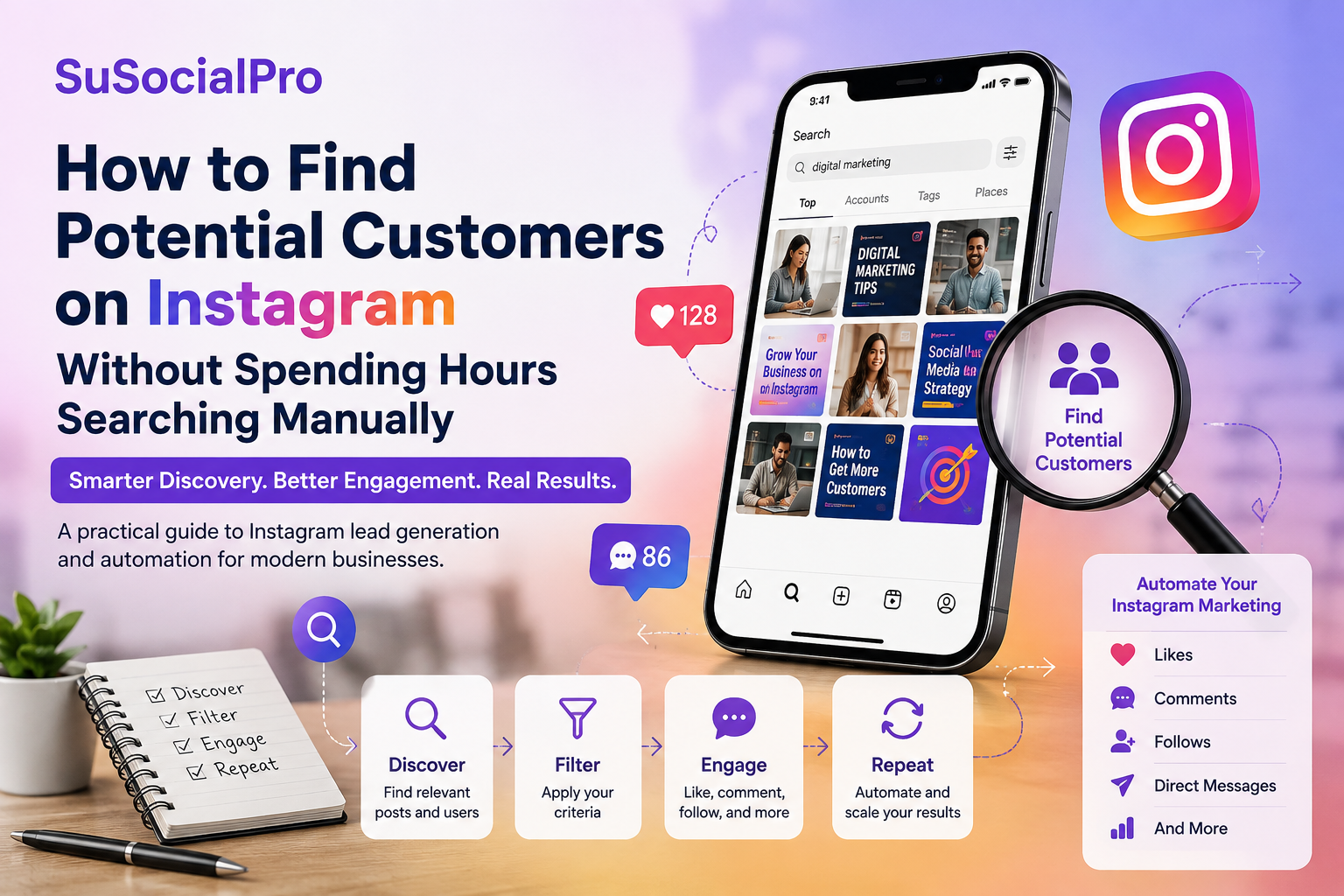
A better way to think about Instagram customer acquisition is to divide it into several stages.
1. Discover
First, find content and users related to your target market.
Keywords can be useful here.
For example, an e-commerce marketing agency might search for topics related to:
- Shopify
- e-commerce
- online stores
- product marketing
- Instagram shopping
The goal is not to collect everyone.
The goal is to discover relevant opportunities.
2. Filter
Not every result is valuable.
You may want to apply filters based on your own campaign requirements.
For example:
- Is this account relevant to my industry?
- Is the content recent?
- Does the user appear to be an actual business?
- Is the conversation related to a problem I can solve?
The filtering stage is important because more data does not automatically mean better leads.
3. Engage
Once you find relevant users or posts, the next question is:
How do you get noticed?
This is where activities such as likes, comments, and follows can become part of an Instagram marketing workflow.
But there is an important distinction.
The goal should not be:
“Comment on as many posts as possible.”
The better goal is:
Interact with relevant people in relevant conversations.
That difference matters.
A useful comment can start a conversation.
A meaningless comment is simply noise.
4. Continue
Customer acquisition rarely happens from one action.
Someone may see your comment today.
They may visit your profile tomorrow.
They may follow you next week.
And perhaps later they become interested in your product or service.
That is why Instagram marketing is better understood as an ongoing process rather than a single action.
Where SuSocialPro Fits Into This Process
This is where a social media automation tool such as SuSocialPro can become useful.
The basic idea is simple.
Instead of manually repeating every step, you can build a workflow around:
Discover → Filter → Collect → Engage → Repeat
For example, you can use keyword-based tools to discover relevant Instagram posts or users.
Then you can review and filter the results according to your own requirements.
After that, you can use automation for repetitive social media activities such as likes, comments, follows, and other supported tasks.
The important point is that SuSocialPro is not a magic database that simply gives you a list of “perfect customers.”
That is not how social media customer acquisition works.
Instead, it can help you work with the information and opportunities that already exist on social media.
Automation Does Not Replace Marketing Strategy
This is another point that is easy to misunderstand.
Some people hear “Instagram automation” and immediately think:
Find thousands of users → automatically message everyone → get customers.
That is not a good marketing strategy.
Automation cannot decide whether your offer is actually useful.
It cannot replace good content.
It cannot replace understanding your target customer.
And it cannot turn an irrelevant audience into qualified prospects.
What automation can do is help with repetitive parts of the workflow.
Think about Michael again.
He still needs to decide:
Who is my ideal customer?
He still needs to decide:
What keywords should I search for?
He still needs to decide:
Which posts and users are actually relevant?
And he still needs to decide:
What should my brand say when engaging with them?
The software can help reduce repetitive execution.
The strategy still comes from the marketer.
The Difference Between “More Activity” and “Better Activity”
This is probably the biggest lesson from Instagram lead generation.
You don't necessarily need to interact with more people.
You need to interact with more relevant people.
Imagine two marketers.
Marketer A interacts with 5,000 random accounts.
Marketer B discovers 500 accounts that are closely related to the business and focuses on relevant content and conversations.
Which strategy is better?
The answer is not simply determined by the number of actions.
Because social media marketing is not a numbers game where the biggest number always wins.
Relevance matters.
A smaller number of meaningful interactions can be more valuable than a huge number of random actions.
Instagram Customer Acquisition Is Really About Discovery
This is why I would describe Instagram lead generation in a slightly different way.
It is not simply:
“How many followers can I get?”
It is:
“Can I consistently discover people who may have a problem that my business can solve?”
Once you think about Instagram this way, the workflow becomes much clearer.
You look for relevant conversations.
You identify relevant users.
You filter the results.
You engage with the right people.
Then you continue building visibility over time.
Automation simply helps make the repetitive parts of that process easier to manage.
So, Is Instagram Automation Worth Using?
I think the answer depends on how you use it.
If your strategy is:
“Let's automate everything and hope customers appear.”
Probably not.
But if your strategy is:
“I already know who I want to reach. I know what conversations are relevant. I want to spend less time doing repetitive searches and repetitive social actions.”
Then automation can make much more sense.
For marketers like Michael, the real benefit is not simply doing more Instagram actions.
It is creating a repeatable customer discovery workflow.
Find the right conversations.
Find the right people.
Engage with them.
Keep doing it consistently.
That is a much more realistic way to think about Instagram marketing automation.
Final Thought
Instagram has no shortage of people.
The difficult part is finding the right people at the right moment.
And sometimes, those people are not sitting on a list waiting to be downloaded.
They are already posting.
They are asking questions.
They are talking about problems.
They are looking for solutions.
That is why a good Instagram lead generation strategy should start with discovery, not simply with a list of usernames.
And when the discovery process becomes too repetitive to handle manually, automation can help turn that process into something more systematic.
SuSocialPro is built around this kind of social media workflow: helping businesses discover relevant content and users, organize their targeting process, and automate repetitive social media activities at scale.
The goal is not to replace human marketing.
The goal is to give marketers more time to do the part that automation cannot replace:
understanding customers and building relationships.